

When most people think of garnet, they picture a deep red gemstone in vintage jewelry. But garnet isn’t a single mineral at all. It’s an entire group of silicate minerals that share a similar crystal structure while varying dramatically in chemical composition and appearance.
This article is designed for gem enthusiasts, students, and industry professionals who want to deepen their understanding of garnet characteristics. Knowing these properties is essential for identifying garnet varieties, selecting suitable stones for jewelry or industrial use, and appreciating their geological and cultural significance.
This distinction matters because garnet characteristics extend far beyond the familiar reddish shades. Natural garnets occur in nearly every colour imaginable, from vivid mandarin orange to bright green, purple, pink, brown, and even rare blue. Those blue garnets weren’t even confirmed until the 1990s, when low-iron pyrope-spessartine specimens from Madagascar and Tanzania rewrote what gemologists thought possible.
Overview of Garnet Characteristics
Garnet serves dual purposes in modern commerce. As the January birthstone with roots stretching to ancient times and part of the wider tradition of monthly birthstones associated with protection and personal meaning, it commands attention in the gem world. Simultaneously, millions of tons of garnet sand power industrial applications from sandblasting to water jet cutting each year.
The main garnet characteristics worth understanding include:
-
Colour range: From deep red through orange, yellow, green, purple, pink, rare blue, and even colorless varieties
-
Hardness: Approximately 6.0 to 7.5 on the Mohs scale depending on composition
-
Crystal system: Cubic (isometric) with three axes of equal length
-
Crystal habit: Typically dodecahedrons (12-sided) or trapezohedrons (24-sided)
-
Transparency: Ranges from gemstone quality transparent specimens to opaque varieties used as abrasives
-
Specific gravity: 3.47 to 4.30, increasing with iron content
Additional Garnet Characteristics
To ensure a comprehensive understanding, here are further notable garnet characteristics:
-
Colorless and yellow varieties: In addition to red, orange, and green, garnets can also be colorless, yellow, and orange-brown, depending on the species.
-
Color change: Some garnets, such as pyrope-spessartine, exhibit color change, shifting from blue-green in daylight to purple under incandescent light.
-
Moderate to high dispersion: Most garnets show moderate dispersion, but varieties like demantoid have higher dispersion, resulting in exceptional fire.
-
Luster: Garnets can display a vitreous (glass-like) to resinous luster, enhancing their visual appeal.
-
High refractive index: Garnets typically have a high refractive index (1.714 to 1.888), contributing to their brilliance and sparkle.
-
Asterism/star garnets: Certain almandine garnets can form star garnets that display four or six rays, producing asterism when cut into cabochons.
These properties make garnet versatile enough for both fine jewelry and heavy industry, a combination few minerals can match.
Physical and Optical Properties of Garnet
All natural garnets share an isometric crystal structure built from isolated silicon-oxygen tetrahedra linked by metal cations. However, substitutions at key atomic sites profoundly alter density, refractive index, hardness, and especially colour. This means a single garnet group encompasses stones that look nothing alike.
Color Variations
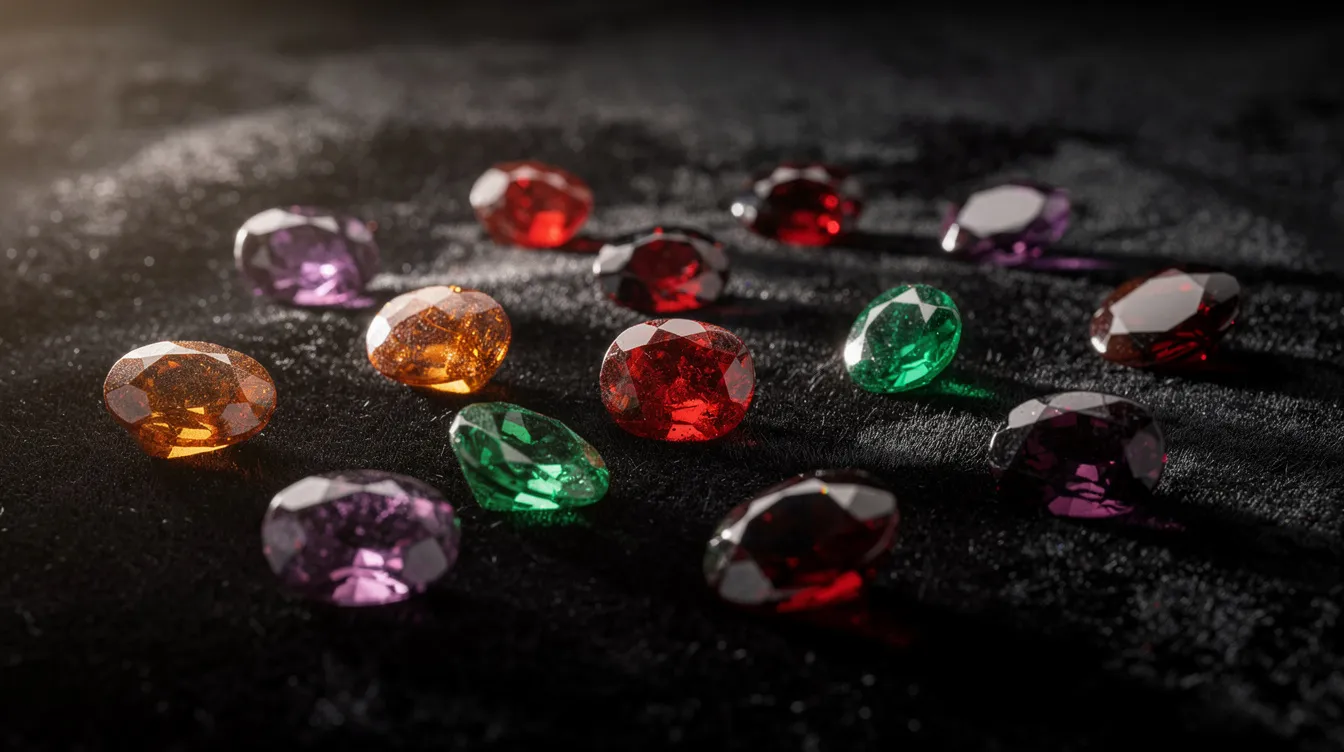
Colour in garnets ranges dramatically based on trace element chemistry:
-
Deep red to brownish red: Almandine (iron-rich) and pyrope (magnesium-rich), the most commonly found garnet colours
-
Orange to mandarin: Spessartine containing manganese, with exceptional specimens from Namibia and Nigeria
-
Bright green: Tsavorite garnet, a rare, vivid emerald-green variety coloured by vanadium or chromium, along with demantoid andradite
-
Yellow to honey brown: Hessonite grossular, sometimes called cinnamon stone variety
-
Purple to raspberry: Rhodolite, a pyrope-almandine blend
-
Blue: Extremely rare pyrope-spessartine stones discovered in East Africa during the late 20th century that exhibit color change, shifting from blue-green in daylight to purple under incandescent light
-
Colorless and yellow: Some garnet species can be colorless or yellow, expanding the color palette beyond the more familiar hues
Crystal Structure
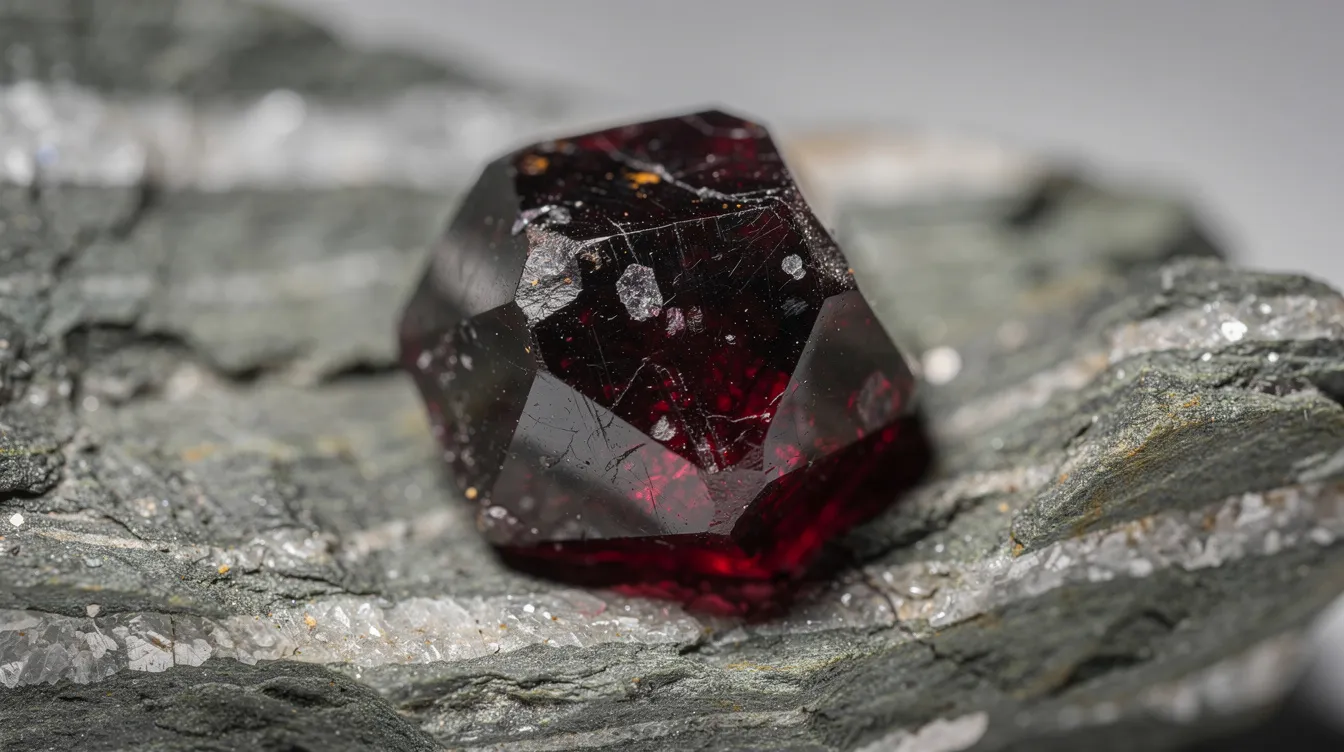
The cubic crystal system produces garnet crystals with distinctive rounded forms. Pure crystals rarely form perfect cubes. Instead, they typically appear as 12-sided dodecahedrons or 24-sided trapezohedrons. Many gem garnets found in alluvial deposits appear as water-worn pebbles rather than sharp-edged crystals.
Hardness
Hardness varies from 6.0 to 7.5 on the Mohs scale. Understanding the Mohs hardness scale helps buyers judge how suitable different garnet species are for daily wear.
-
Almandine and pyrope: Occupy the harder end, making them excellent for both jewelry and abrasives.
-
Andradite: Tends toward 6.5 to 7.0, requiring more careful handling in rings and bracelets.
Optical Properties
Key optical properties include:
-
High refractive index: Ranging from 1.714 to 1.888, creating strong brilliance and sparkle
-
Single refraction: (Isotropic), useful for distinguishing garnet from birefringent lookalikes like ruby
-
Luster: Garnets can exhibit a vitreous to resinous luster, contributing to their visual appeal
-
Dispersion: Most garnets show moderate dispersion, but varieties such as demantoid have higher dispersion (0.057), exceeding diamond’s 0.044 and producing exceptional fire under incandescent light
-
Asterism: Certain almandine garnets can form star garnets that display four or six rays, producing a star-like reflection when cut into cabochons
-
Color change: Some garnets, especially pyrope-spessartine varieties, can exhibit color change depending on lighting conditions
Transparency grades from eye-clean transparent gems suitable for faceting to translucent hessonites and completely opaque industrial material with a dark red to reddish brown appearance.
Magnetic and Diagnostic Characteristics
Garnets possess distinctive physical responses that separate them from similar-looking gemstones in the gem trade. These diagnostic traits prove invaluable for gemologists, appraisers, and rough dealers alike.
Magnetic Response
-
Iron-rich almandine: Shows noticeable attraction to strong neodymium magnets due to paramagnetic ferrous iron and ferric iron content.
-
Calcium or magnesium-dominant varieties: Such as tsavorite or demantoid, demonstrate negligible magnetic pull.
-
Rhodolite: Shows intermediate magnetic attraction reflecting its pyrope-almandine chemistry.
Gemologists quantify this response using hand-magnet tests or specialized magnetic susceptibility balances.
Additional Diagnostic Traits
-
Typical rounded dodecahedral crystal forms in host rock
-
Hardness sufficient to scratch window glass (above 5.5 Mohs)
-
Absence of cleavage, producing conchoidal fracture patterns rather than clean splits
-
Characteristic inclusions visible under magnification
These diagnostic traits serve practical purposes in jewelry appraisal, helping authenticate stones and determine appropriate valuations. In mining operations, density-based sorting using spirals and jigs separates garnet rough from alluvial gravels efficiently.
Chemical Composition and Garnet Group Classification
Garnet is not a single mineral but a group of minerals with six primary gem-quality species: Pyrope, Almandine, Spessartine, Grossular, Andradite, and Uvarovite. These are classified into two main groups based on their chemical composition: aluminium silicates and calcium silicates, each capable of producing gem-quality stones.
Garnets are nesosilicates, meaning they are silicate minerals in which the silicon-oxygen tetrahedra are isolated and not directly linked to each other. The general formula for garnet is X₃Y₂(SiO₄)₃, where the X site is typically occupied by larger divalent cations such as calcium (Ca), magnesium (Mg), iron (Fe), or manganese (Mn), and the Y site by smaller trivalent cations like aluminium (Al), iron (Fe), or chromium (Cr).
This structural flexibility enables extensive solid-solution series. Most natural garnets are chemical mixtures rather than pure end-members. A single crystal might show compositional zoning from core to rim, recording changes in pressure and temperature during formation.
Garnet Group Classification
The garnet group divides into two main gem-forming subgroups:
Pyralspite Group (Aluminium-dominant Y site)
-
Pyrope: Mg₃Al₂(SiO₄)₃
-
Almandine: Fe₃Al₂(SiO₄)₃
-
Spessartine: Mn₃Al₂(SiO₄)₃
Ugrandite Group (Calcium-dominant X site)
-
Uvarovite: Ca₃Cr₂(SiO₄)₃ (calcium chromium garnet)
-
Grossular: Ca₃Al₂(SiO₄)₃ (grossular garnet)
-
Andradite: Ca₃Fe₂(SiO₄)₃ (calcium iron garnet)
The calcium silicate garnets include andradite, grossular, and uvarovite, with andradite being known for its bright green variety called demantoid, which is highly prized in jewelry.
Trace Element Chemistry
-
Chromium and vanadium: Produce vivid greens in tsavorite and demantoid.
-
Manganese: Creates orange hues in spessartine.
-
Iron: Generates red seeds of colour in almandine and brown tones in various compositions.
Even minor impurities measured in fractions of a percent can dramatically shift a stone’s appearance.
Gem-Quality Garnet Species and Varieties
Six principal garnet species yield gem quality material, though trade names often emphasize colour or locality rather than strict mineralogy. Understanding these garnet varieties helps buyers navigate market terminology.
Pyralspite (Aluminium) Garnets
-
Pyrope: Deep red to nearly black, with classic Bohemian specimens historically from the Czech Republic. Modern sources include Mozambique and Arizona. Stones exceeding 10 carats remain rare.
-
Almandine: The most abundant garnet type, showing dark red to brownish red colouration. Commonly found in schists worldwide, it serves both affordable jewelry and industrial abrasive markets. Certain almandine garnets can form star garnets that display four or six rays.
-
Spessartine: Orange to vivid mandarin orange coloration from manganese content. Important deposits in Namibia and Nigeria produce highly prized stones, with fine specimens commanding over $1000 per carat.
-
Rhodolite: A pyrope-almandine mixture displaying raspberry to purplish-red hues. Named in North Carolina during the 1890s, rhodolite remains popular for its bright colour and good transparency at accessible prices.
Ugrandite (Calcium) Garnets
-
Grossular: Extraordinarily diverse, ranging from colourless through honey-coloured hessonite to the prized green garnet known as tsavorite. Campbell Bridges discovered tsavorite near Tsavo National Park in Kenya during the late 1960s, and Tiffany & Co. subsequently promoted these bright green gems to international markets. Fine tsavorites rival emerald in colour and exceed it in durability, inviting comparison with other iconic green gems such as jadeite and emerald.
-
Andradite: Includes demantoid (green with exceptional dispersion and signature horsetail inclusions, famous from Russia’s Ural Mountains), melanite (black, titanium-rich), and topazolite (yellow-green). Russian demantoid with visible horsetail inclusions commands premium prices from collectors.
-
Uvarovite: Saturated emerald-green crystals, typically too small for faceting but stunning as sparkling drusy coatings. Most specimens originate from Russian deposits.
Rare Species
-
Knorringite (Mg-Cr garnet): Rarely occurs in pure form but appears in mantle garnet compositions from kimberlites, where it serves as an indicator mineral for diamond exploration.
Colour saturation, brilliance, rarity, and documented origin largely determine value. Russian demantoid, Kenyan tsavorite, and fine colour-change garnets range from hundreds to thousands of dollars per carat for exceptional stones, making them particularly suited to handmade birthstone jewellery with personalised significance.
Geological Occurrence and Metamorphic Significance
Garnet functions as a key index mineral in metamorphic rocks and appears in certain igneous rocks, particularly those sourced from Earth’s upper mantle.
Metamorphic Settings
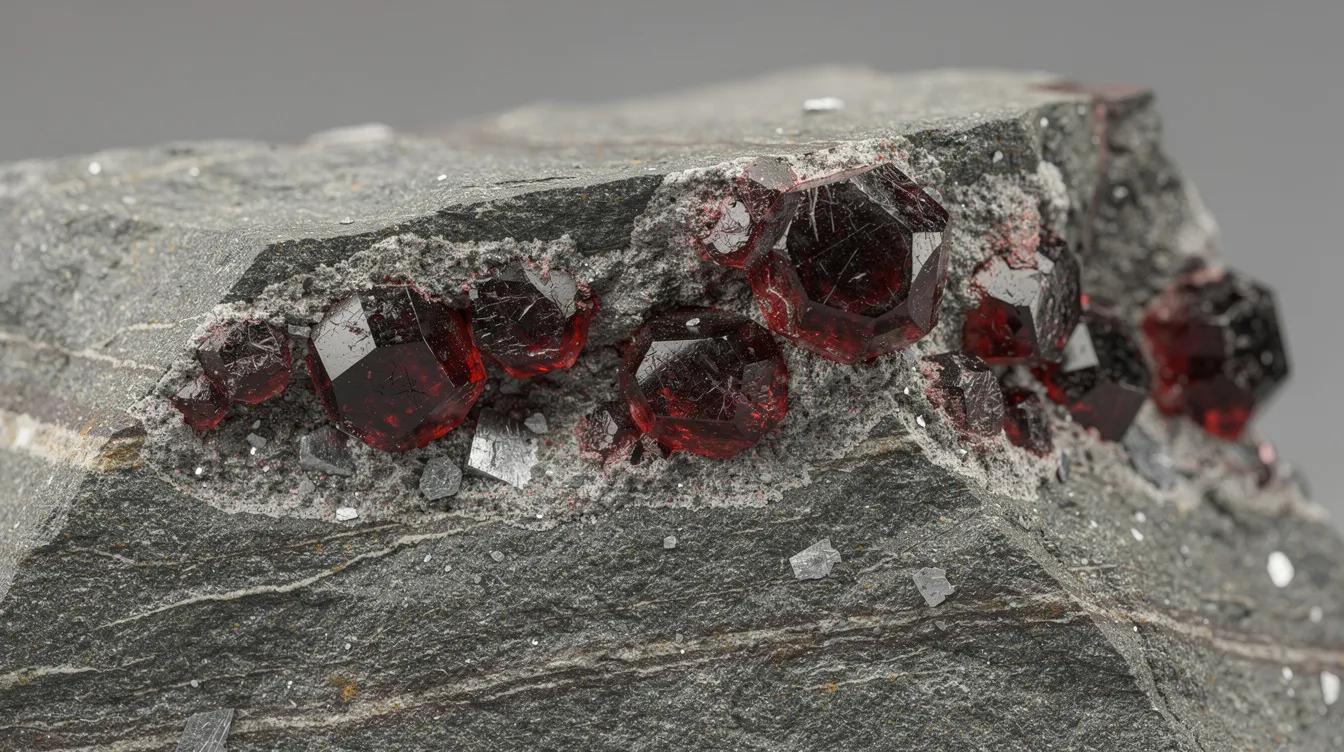
Garnets are commonly found in metamorphic rocks and are stable at high pressures and temperatures, making them significant indicators of metamorphic conditions.
-
Almandine-rich: Forms in pelitic (clay-rich) schists during regional metamorphism
-
Grossular-rich: Develops in metamorphosed limestones and skarn deposits
-
Andradite: Appears in calc-silicate and contact-metamorphic rocks
-
Pyrope-rich: Occurs in peridotite xenoliths and kimberlites from mantle depths exceeding 140 kilometres
Geological Significance
-
Mantle-derived pyrope serves as a diamond indicator mineral because both form under similar high-pressure, high-temperature conditions.
-
Exploration geologists sample stream sediments for these distinctive garnets when prospecting for diamond-bearing kimberlites in South Africa and elsewhere.
-
Garnets can record the pressures and temperatures of peak metamorphism, serving as geobarometers and geothermometers in geological studies.
-
The composition of garnets varies with the metamorphic conditions, allowing geologists to use them to gauge a rock's metamorphic grade and history.
Economic Deposits
-
The Gore Mountain garnet deposit in New York State, formed during the Grenvillian orogeny approximately 1.05 billion years ago, produces giant industrial garnets occurring up to 37 centimetres across, with crystals averaging 10 centimetres in hornblende matrix.
-
Garnets weather slowly due to their hardness and lack of cleavage. This resistance concentrates dense garnet sand in placer beach and river deposits, creating economically significant heavy mineral accumulations in Western Australia’s Port Gregory region and throughout India.
Synthetic and Technological Garnets
Beyond natural gemstones, synthetic garnets with engineered compositions play crucial roles in optics, electronics, and laser technology. These materials share the garnet crystal structure but substitute various rare-earth or transition metals to achieve specific properties.
Key Synthetic Garnet Materials
-
Yttrium Aluminium Garnet (YAG): A colourless host crystal used in solid-state lasers, particularly Nd:YAG systems operating at 1064nm for industrial cutting, welding, and medical applications. YAG also served as a diamond simulant in jewelry during the 1960s.
-
Yttrium Iron Garnet (YIG): A ferrimagnetic material with extremely low energy losses, essential for microwave filters, resonators, and spintronic research operating in the 1-100 GHz range.
-
Gadolinium Gallium Garnet (GGG): Used in magnetic refrigeration and as substrate material for other thin-film applications.
-
Terbium Gallium Garnet (TGG): Serves as Faraday rotators in optical isolators across wavelengths from 400 to 5000 nanometres.
-
Lutetium Aluminium Garnet (LuAG): Cerium-doped versions function as scintillators in PET medical imaging scanners.
-
Lithium-stuffed garnets: Like Li₇La₃Zr₂O₁₂ (LLZO), offer promising solid electrolyte properties for next-generation rechargeable batteries, potentially enabling safer solid-state designs that eliminate flammable liquid electrolytes.
Synthetic Gem Garnets
-
Synthetic gem garnets are also grown for jewelry applications, often displaying ideal colour and clarity.
-
However, natural stones with characteristic inclusions remain preferred in high-end markets.
Economic Uses and Industrial Characteristics
While gem quality garnets capture attention for their beauty, the bulk of global production serves industrial applications. Garnet’s combination of hardness, angular conchoidal fracture, and chemical inertness makes it ideal for numerous processes.
Major Abrasive Applications
-
Sandblasting: Cleaning steel structures, ship hulls, and stone surfaces at pressures around 80 psi, with garnet lasting twice as long as slag alternatives. Garnet sand is a common replacement for silica sand in abrasive blasting operations due to its hardness and safety, as silica dust is linked to health issues like silicosis.
-
Water jet cutting: Precision cutting of metals, ceramics, glass, and composites at speeds up to 300 metres per minute using 80 or 120 mesh garnet
-
Polishing: Finishing optical components and semiconductor wafers to exacting tolerances
Additional Industrial Uses
-
Filtration media: In water treatment plants, trapping over 99% of particulates
-
Skid-resistant aggregate: In road surfacing and non-slip coatings
-
Specialty fillers: In concrete and industrial coatings
Health and Safety Advantages
-
Garnet sand provides significant health advantages over silica sand. It generates less respirable dust, reducing silicosis risk for workers in blasting and cutting operations.
-
Garnet paper serves woodworking and metalworking applications where controlled abrasion is required.
Major Producing Regions
-
Australia’s Port Gregory operations (yielding approximately 50,000 tonnes annually)
-
India (with reserves estimated at 50 million tonnes in Rajasthan alone)
-
Various US deposits including historic Barton Mines operations in New York
Cultural History, Symbolism and Care of Garnet Gemstones
Garnet’s cultural significance spans millennia. Beads and inlay work featuring garnet appear in Bronze Age sites including Indus Valley and Sumerian settlements dating to approximately 3000 BCE. Egyptian artisans set garnets in pharaonic jewelry, with specimens recovered from Tutankhamun’s tomb — a long tradition now echoed in modern birthstone jewellery trends transforming designs in 2025.
Historical and Cultural Significance
-
Greek craftsmen carved garnet intaglios for signet rings, while Roman nobles used garnet signets for pressing wax seals on important documents. Pliny the Elder wrote about “carbunculus” in his Natural History, recognizing garnet’s distinctive glow.
-
The 6th to 7th century Staffordshire Hoard discovered in England contains over 2,500 cloisonné garnets set into Anglo-Saxon sword fittings and jewelry, demonstrating sophisticated metalworking techniques.
-
Throughout the Middle Ages, travellers believed garnet provided protection on journeys, a legend connecting to Noah’s supposed use of a glowing garnet lantern on the ark, and inspiring today’s popularity of crystal bracelets worn daily for perceived benefits.
Modern Symbolism
-
January birthstones, including garnet and rose quartz (designated 1912), often celebrated in gold-plated January birthstone necklaces pairing garnet with carnation motifs
-
Traditional gift for second wedding anniversaries, especially when chosen as handcrafted gemstone pieces that elevate personal style
-
Associations with friendship, loyalty, and safe travel, much like the protective and spiritual symbolism often linked to February’s amethyst birthstone
Care Guidelines
Most garnets prove durable enough for everyday jewelry including rings and bracelets, whether set in solid metals or high-quality gold plated jewellery. Basic precautions include:
-
Avoid hard knocks and rough handling, especially for softer andradite varieties
-
Clean with warm soapy water and a soft brush
-
Use ultrasonic cleaners cautiously, only for eye-clean stones without visible inclusions or fractures
-
Avoid steam cleaning for included specimens
-
Store separately from harder gems like diamond or sapphire to prevent scratching
Garnets remain generally stable to light and household chemicals, rarely fading or discolouring under normal wear conditions. Unlike some other minerals, garnets don’t require special storage away from light, and they sit comfortably alongside other birthstones such as emerald, the May birthstone symbolising renewal and love.
Understanding garnet characteristics, from chemical composition to physical durability to cultural significance, helps buyers select appropriate stones for their intended purpose. Whether choosing a tsavorite pendant for its rarity and colour, an almandine ring for everyday affordability, or appreciating the historical craftsmanship of antique garnet jewelry, knowledge of these properties ensures confident decisions and lasting satisfaction with these remarkable gems, especially when combined with other meaningful pieces like September sapphire birthstone necklaces with symbolic floral motifs.
Frequently Asked Questions about Garnet Characteristics
What are red garnets and why are they so popular?
Red garnets, primarily pyrope and almandine species, are the most commonly recognized garnet varieties. Their deep red to reddish-brown hues have made them popular gemstones throughout history, often symbolizing passion and protection. Their durability and attractive color make them ideal for a wide range of jewelry, from classic pieces to colourful birthstone designs featuring options like December’s tanzanite, turquoise, zircon, and blue topaz, as explored in our broader jewellery articles on gemstone styles and trends.
How does the crystal structure affect garnet properties?
Garnets crystallize in the cubic (isometric) system, typically forming dodecahedral or trapezohedral crystal habits. This crystal structure lacks cleavage planes, resulting in a conchoidal, glass-like fracture when broken. This contributes to their toughness and suitability as abrasives.
What causes the color variations in garnets?
The wide color range in garnets arises from different trace elements substituting into their crystal structure. For example, chromium and vanadium produce bright green hues in tsavorite and demantoid garnets, manganese creates orange tones in spessartine, and iron imparts red shades in almandine.
Are garnets used outside of jewelry?
Yes, garnet sand is widely used industrially for abrasive blasting and water jet cutting due to its hardness and angular fracture. It is a safer alternative to silica sand, which poses health risks like silicosis. Garnet also serves as a filtration medium and in polishing applications.
What is the significance of garnet in geology?
Garnets are important metamorphic indicators because their composition and zoning record the pressure and temperature conditions during rock formation. Geologists use garnet characteristics to understand metamorphic histories and tectonic processes.
Who is John Wiley and what is his connection to garnets?
John Wiley & Sons is a well-known publisher of scientific and technical literature, including authoritative texts on mineralogy and gemology that cover garnet characteristics in detail. Their publications are often referenced in academic and professional studies of garnets.
What does 'glass like' mean in relation to garnets?
'Glass like' refers to the vitreous luster garnets often exhibit, meaning their surface reflects light similarly to glass. This luster enhances their brilliance and visual appeal in gemstone-quality specimens.
Can garnets change color?
Some garnets, especially pyrope-spessartine varieties, can exhibit color change depending on lighting conditions, shifting from blue-green in daylight to purple under incandescent light. This rare trait adds to their desirability among collectors.
How hard are garnets?
Garnets have a hardness ranging from 6.0 to 7.5 on the Mohs scale. Harder species like almandine are durable enough for everyday jewelry and also useful as abrasives.
What care do garnet gemstones require?
Garnets are generally durable but should be cleaned with warm soapy water and a soft brush. Avoid harsh chemicals and ultrasonic cleaners if inclusions or fractures are present. Store garnet jewelry separately to prevent scratching from harder stones.
Leave a comment