

When it comes to iconic green gemstones, two names dominate the conversation: emerald and jadeite. Both command serious prices at auction, both carry centuries of cultural weight, and both can display that coveted vivid green color that stops people in their tracks. Jade and emerald have been treasured throughout history for their symbolic meanings, representing power, purity, and status in various cultures.
But here’s the thing—these two stones couldn’t be more different.
Emerald is a transparent, crystalline gem that sparkles under light. Green jade, on the other hand, is a dense, waxy stone prized for its soft inner glow, unique translucency, and subtle color variations, making it visually distinct from emerald. One comes from beryl, the other from pyroxene. One is typically faceted into rings and pendants, the other carved into bangles and figurines.
Jadeite forms under high pressure in metamorphic rocks within the earth's crust, while emerald typically grows in pegmatites or hydrothermal veins, highlighting their different geological origins. Jade is found in many locations including China, Myanmar, and Canada, reflecting its global significance.
Understanding the difference between jadeite vs emerald isn’t just academic. It affects what you pay, how you wear it, and what that stone means to you and your culture. Each is considered a precious mineral, valued not only for its beauty but also for its deep cultural and historical importance.
In this guide, you’ll learn exactly how to distinguish these two gemstones, when to choose one over the other, and what to watch out for when shopping for either.
Quick Answer: Jadeite vs Emerald at a Glance
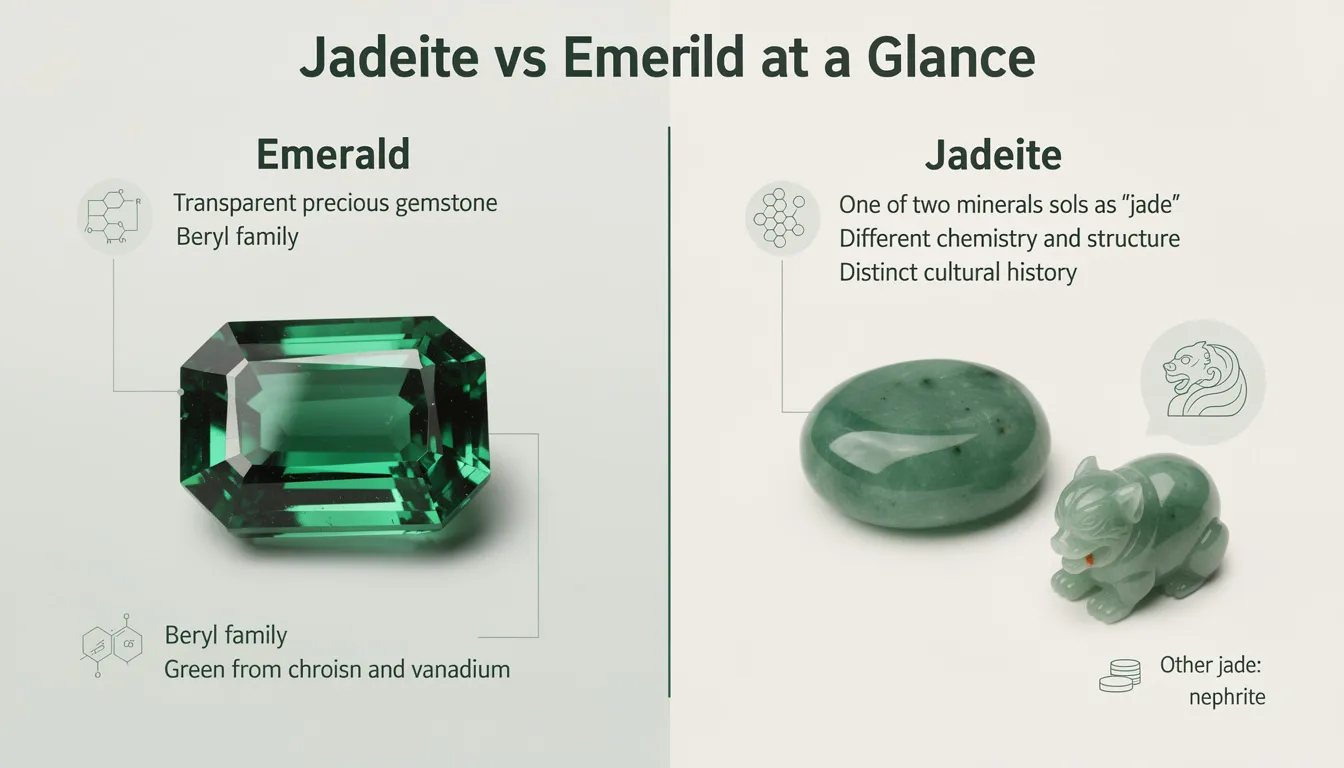
Emerald is a transparent precious gemstone belonging to the mineral beryl family, colored green by chromium and vanadium. Jadeite, on the other hand, is one of two minerals sold as “jade” (the other being nephrite jade) and has a completely different chemistry, structure, and cultural history.
Here’s a fast comparison to orient you:
|
Feature |
Emerald |
Jadeite |
|---|---|---|
|
Composition |
Beryl (Be₃Al₂Si₆O₁₈) |
Pyroxene (NaAlSi₂O₆) |
|
Appearance |
Glassy, transparent, brilliant |
Waxy, translucent to opaque, glowing |
|
Typical Cut |
Faceted (emerald cut, oval) |
Cabochon, beads, carvings, bangles |
|
Mohs Hardness |
7.5–8 |
6.5–7 |
|
Toughness |
Low (brittle) |
Very high (extremely tough) |
|
Price Range |
$50–$100,000+ per carat¹ |
$10–$3,000,000+ per piece |
¹Emeralds are generally more expensive than jade due to their rarity and demand.
Emerald ranks higher on the Mohs scale, meaning it resists scratching better. But it’s also more brittle due to imperfect cleavage and internal fractures. Jadeite is slightly softer but far tougher—which is why you’ll see thin jadeite bangles survive decades of daily wear while emerald rings need protective settings.
When it comes to price and value, the cost of each gemstone depends on factors like quality, rarity, and demand. For gemstones of the same quality, emeralds are typically more expensive than jadeite, largely because emeralds are rarer and in higher demand.
Modern examples show this contrast clearly:
-
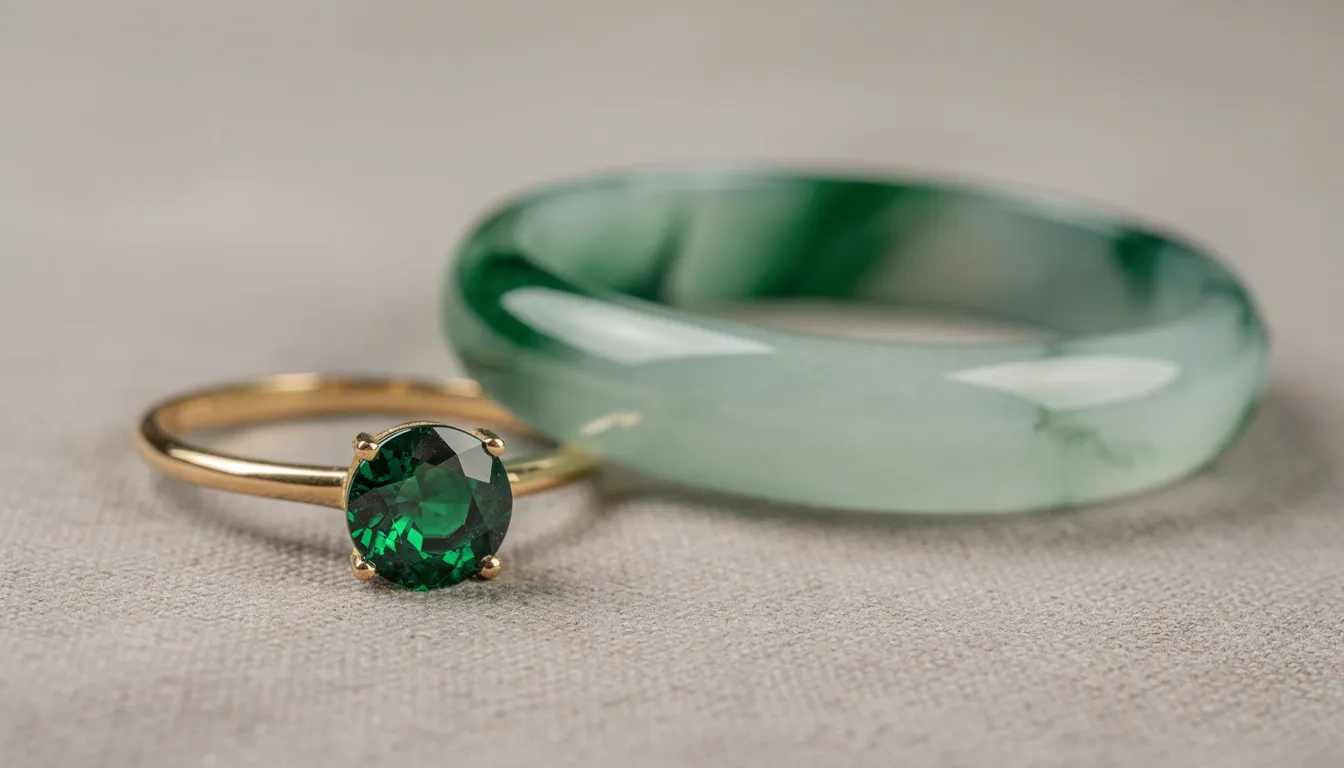
Colombian emerald engagement rings remain the Western gold standard for green gemstone jewelry, often set with diamond halos for protection
-
Burmese imperial jadeite bangles regularly sell for millions at Hong Kong auctions, prized for their cultural significance and durability
Bottom line: Choose emerald for brilliance, sparkle, and Western prestige. Choose jadeite for cultural meaning, toughness, and that distinctive soft glow.
What Is Emerald?
Emerald is the green variety of beryl, a mineral that also includes aquamarine (blue) and morganite (pink). Its rich history stretches back to ancient Egypt, where Cleopatra famously claimed emerald mines in the Eastern Desert around 330 BCE. The stone’s green colour comes from trace elements—primarily chromium and sometimes vanadium—substituting into the beryl crystal structure.
Key facts about emerald gemstones:
-
Chemical formula: Be₃Al₂Si₆O₁₈ (beryllium aluminum silicate)
-
Crystal system: Hexagonal, forming elongated prismatic crystals ideal for faceting
-
Color range: Medium to dark green, often with bluish modifiers in Colombian stones or slightly yellowish tones in some Zambian emeralds
-
Transparency: Transparent to translucent, with visible inclusions called “jardin” (French for garden) that are expected and accepted
Emerald holds its place as one of the “big four” precious gemstones alongside diamond, ruby, and sapphire. It’s the official May birthstone in Western tradition and a popular choice for 20th and 55th wedding anniversaries.
In fine jewelry, you’ll find natural emeralds in:
-
Engagement rings (increasingly popular as colored stone alternatives to diamonds)
-
Statement pendants and necklaces
-
High jewelry pieces from houses like Cartier, Van Cleef & Arpels, and Bulgari
-
Typically set in 18K gold or platinum with protective bezels or halo designs
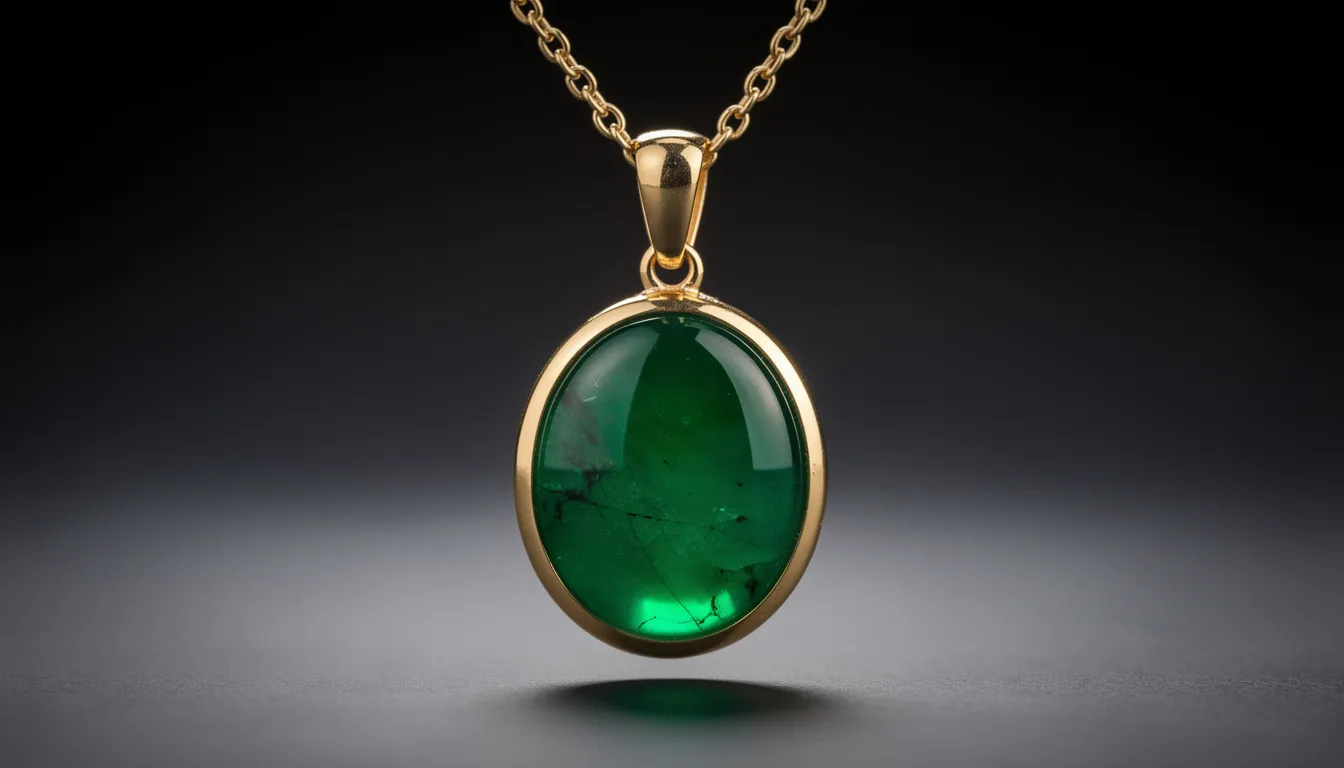
The gemstone’s transparent nature and strong color saturation make it a showstopper when properly cut and set. However, that same transparency reveals inclusions that are nearly universal in mined emeralds—which is why gem dealers accept a higher inclusion tolerance than they would for sapphire or ruby.
What Is Jadeite (and How It Differs from Jade in General)?
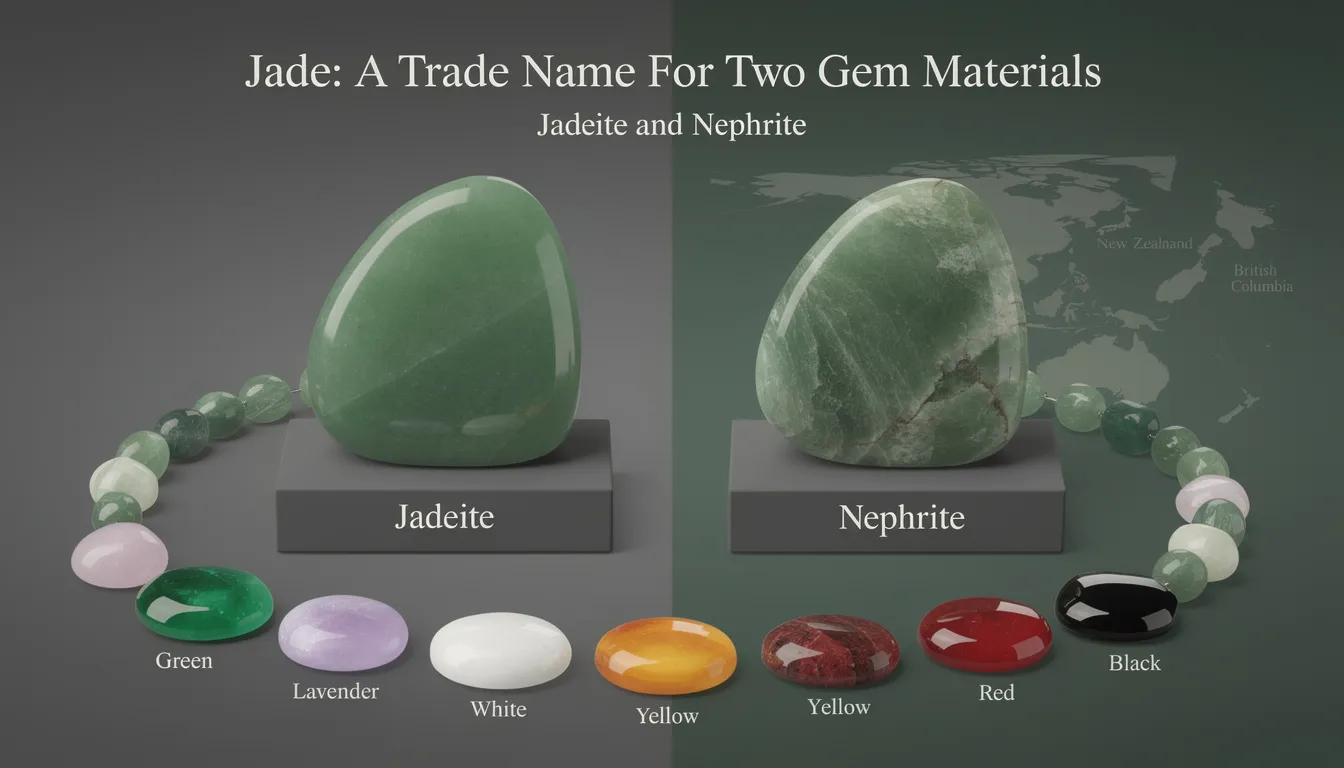
Here’s where terminology gets important. “Jade” isn’t a single mineral—it’s a trade name covering two completely different gem materials: jadeite and nephrite. When most people in the Western world picture jade, they’re often thinking of the softer, more muted nephrite found in places like New Zealand or British Columbia. Jade gemstones come in a wide range of colors, including green, lavender, white, yellow, red, and black, with the green variety being the most famous.
But jadeite is the rarer, more valuable variety, and it’s the one that rivals emerald in prestige and price. Jadeite generally has higher clarity than nephrite jade.
Jadeite’s mineralogy:
-
Chemical formula: NaAlSi₂O₆ (sodium aluminum silicate)
-
Crystal system: Monoclinic pyroxene, forming dense interlocking aggregates rather than single crystals
-
Structure: A felted mass of microscopic crystals that gives jadeite its legendary toughness
Unlike emerald’s transparent brilliance, jadeite jade displays a waxy to oily luster with heightened transparency in only the finest specimens. The stone occurs in many hues—green, lavender, white, yellow, red, and black—but imperial jade refers specifically to the vivid, evenly saturated, chromium-rich green that Chinese emperors prized. The most prized variety of jadeite is 'Imperial Jade,' which is emerald-green and semi-transparent.
The cultural timeline:
-
Myanmar (Burma) has supplied the world’s finest jadeite since at least the 18th century
-
Qing dynasty elites in China embraced Burmese jadeite as the ultimate status symbol
-
Today, Hong Kong and Guangzhou remain the primary trading hubs for high-end jadeite
-
Jadeite is rarer and more valuable than nephrite and is deeply intertwined with spiritual philosophies, especially in Asian and Mesoamerican cultures
Jadeite is traditionally cut into:
-
Thick bangles that must survive the stress of being slipped over the hand
-
Cabochons for rings, earrings, and pendants
-
Carved figures, seals, and decorative items
-
Beaded necklaces, some selling for tens of millions of dollars
When gemologists discuss “jade vs emerald,” they’re almost always comparing fine jadeite specifically—not the more affordable nephrite that dominates mass-market jade jewelry.
Jadeite vs Emerald: Composition, Structure & Appearance
Although emerald and jadeite can share a similar green hue, their chemistry and crystal structure create fundamentally different gemstones. Understanding these physical properties helps explain why they look, feel, and behave so differently. Compared to other gemstones, both jadeite and emerald stand out: jadeite’s luster is more subdued and mystical, while emerald’s glassy shine is more typical of traditional gems.
Chemical composition:
-
Emerald: A cyclosilicate (ring silicate) containing beryllium and aluminum—part of the beryl mineral group
-
Jadeite: A chain silicate (pyroxene) containing sodium and aluminum—completely unrelated to beryl
Crystal structure: Explore the Timeless Elegance: The Art of Handmade Beaded Anklets collection for beautiful examples of artisanal craftsmanship.
-
Emerald forms hexagonal prismatic single crystals, often with visible hexagonal cross-sections, ideal for faceting into brilliant cuts
-
Jadeite forms dense granular aggregates of interlocking microcrystals, which accounts for its extreme toughness but makes it unsuitable for traditional faceting, though it is often fashioned into cabochons like those seen in Moonstone Cabochons Ring
Visual differences at a glance:
|
Characteristic |
Emerald |
Jadeite |
|---|---|---|
|
Luster |
Vitreous (glassy) |
Waxy to oily |
|
Transparency |
Transparent to translucent |
Translucent to opaque |
|
Typical cuts |
Faceted (emerald cut, oval, cushion) |
Cabochon, carvings, beads |
|
Light behavior |
Brilliant sparkle from facets |
Soft internal glow |
|
Texture |
Crystalline with visible inclusions |
Fine-grained, almost “sugary” in top grades |
Emeralds tend to show their characteristic “jardin”—a garden of inclusions including crystals, fractures, and liquid-filled cavities. These are so expected that a completely clean emerald raises suspicion of being lab grown emeralds or heavily treated.
Fine jadeite, in contrast, should display even color distribution with minimal visible grain, dark spots, or white patches. The best imperial jade has an almost jelly-like translucency that seems to glow from within when backlit.
Hardness, Toughness & Everyday Wear
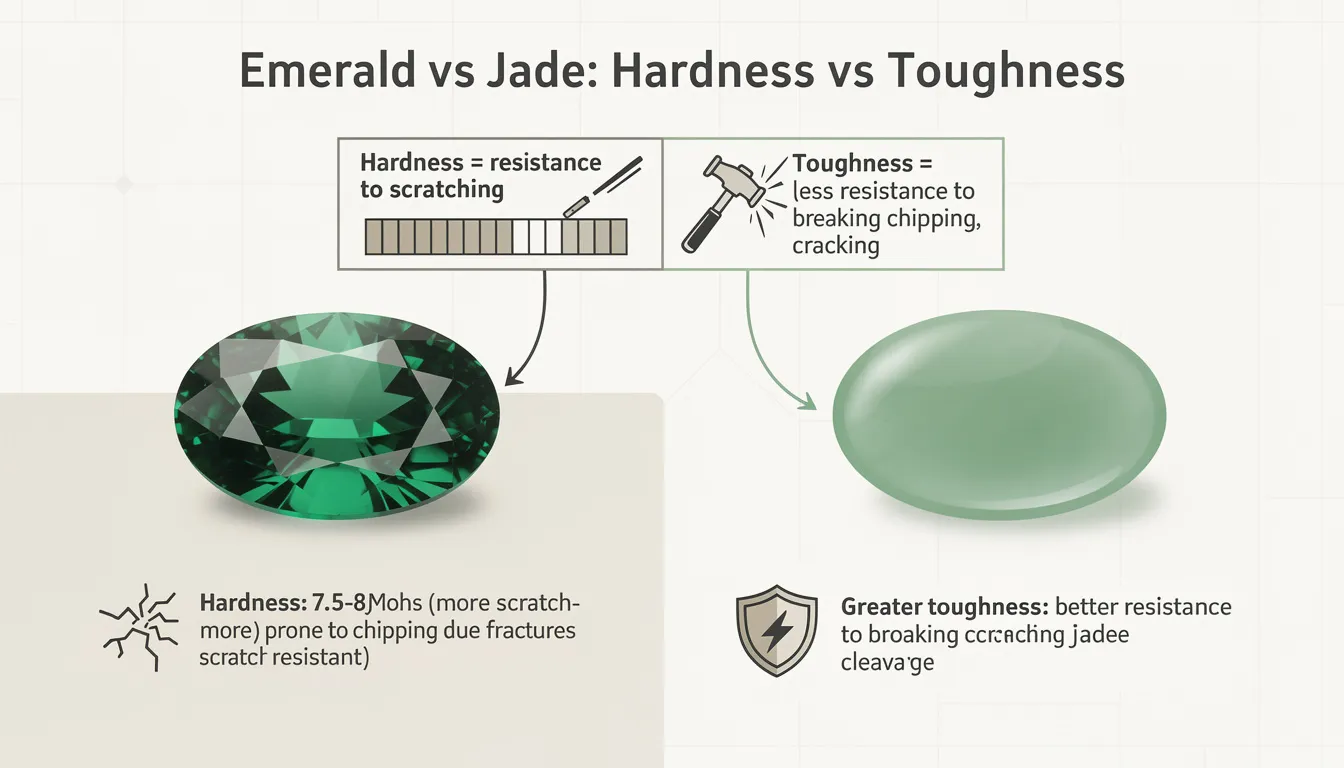
This is where the emerald vs jade comparison gets practical. Many buyers assume that harder equals more durable, but gemology distinguishes between two different properties (a key consideration not only for collectors but also when choosing handmade beaded necklaces featuring semi-precious stones):
-
Hardness: Resistance to scratching (measured on the Mohs scale). A higher hardness means the gemstone is more scratch resistant, which is important for jewelry that is worn daily.
-
Toughness: Resistance to breaking, chipping, and cracking
Emerald rates 7.5–8 on the Mohs scale—harder than jadeite’s 6.5–7. That means emerald resists scratches better. However, emerald has imperfect cleavage and typically contains fractures that make it prone to chipping under impact.
Jadeite is slightly softer but significantly tougher. Its interlocking crystal structure absorbs shock and resists fracturing, which is why thin jade bangles can survive being bumped against doorframes and countertops for years.
Practical wear recommendations:
-
Emerald works best for: Earrings, pendants, and rings with protective settings (bezel or halo designs)—pieces that won’t see heavy impact
-
Jadeite works best for: Bangles, cuffs, statement pendants, rings for daily wear, and any piece that might encounter more physical stress
Care tip: Avoid ultrasonic and steam cleaners for both gemstones. Emerald’s fractures can propagate under vibration, and jadeite may have treatments that can be damaged by aggressive cleaning.
If you work with your hands, jadeite jewelry is the more forgiving choice. If you want that crystalline emerald green in a ring, plan to remove it during activities like gardening, cooking, or sports.
Color: Emerald Green vs Jadeite Green
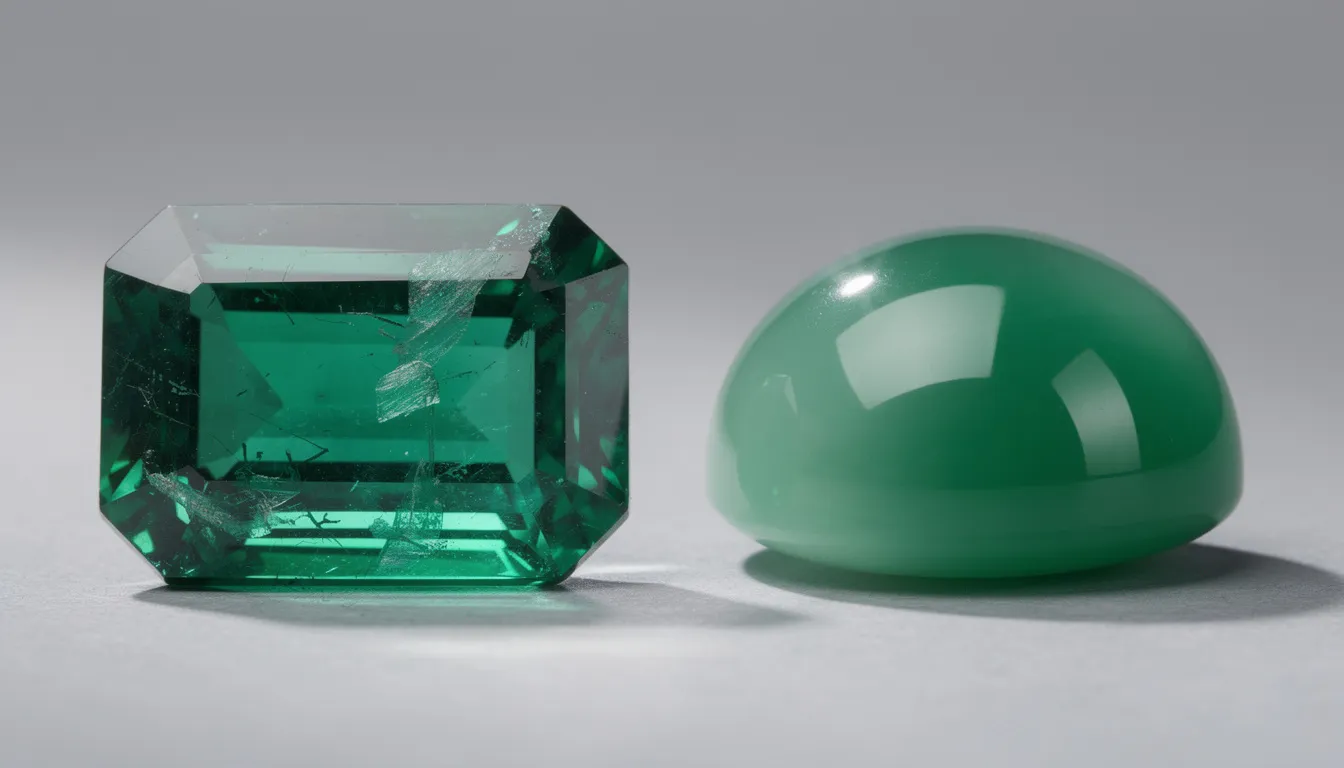
Color is what draws most buyers to these two gemstones, and it’s where the comparison becomes most intuitive. Both can display that prized vivid green color, but they achieve it through different means and with distinctly different visual effects. Emeralds often display a more vivid green hue, with brightness and clarity that set them apart from the more muted tones typically seen in jade.
Emerald color characteristics:
-
Saturated medium to medium-dark green, caused by chromium and/or vanadium trace elements
-
Colombian emeralds often show a slightly bluish green hue, considered the most desirable by many collectors
-
Zambian emeralds tend toward slightly darker, sometimes more bluish tones with better clarity
-
Brazilian emeralds are often lighter with more yellowish modifiers
-
Faceting creates brilliance and sparkle, making emerald appear “electric” and lively
Jadeite color characteristics:
-
Imperial jade displays an evenly saturated, medium to medium-dark translucent green—also chromium-related
-
Lower grades show more muted tones: pale “apple” green, grayish-green, mottled, or streaky patterns
-
The waxy luster and translucency create a soft internal glow rather than sparkle
-
Color evenness is critical—patches, streaks, or white veining significantly lower value
When you hold emerald up to light, it sparkles like a faceted green diamond. When you hold jadeite up to light, it seems to glow from within, with light scattering through its translucent body. For something different entirely, discover how June's birthstone, the pearl, captivates with its unique luminescence and meaning.
The treatment factor: For details about the significance and beauty of October birthstones (Tourmaline) and December birthstones, see this guide to December's three amazing birthstones.
Both stones are routinely enhanced:
-
Emeralds tend to be oiled or resin-filled to reduce the visibility of fractures
-
Jadeite may be bleached and polymer-impregnated (Type B), dyed (Type C), or both (Type B+C)
Untreated stones with strong color saturation command significant premiums for both jadeite and emerald. Always ask for disclosure and, for significant purchases, request laboratory certification.
Lighting matters: Both gemstones can shift in appearance under different light sources. Daylight typically shows truest color, while warm incandescent light may enhance green or add yellow undertones. View stones under multiple lighting conditions before buying.
Sources & Geographic Origins
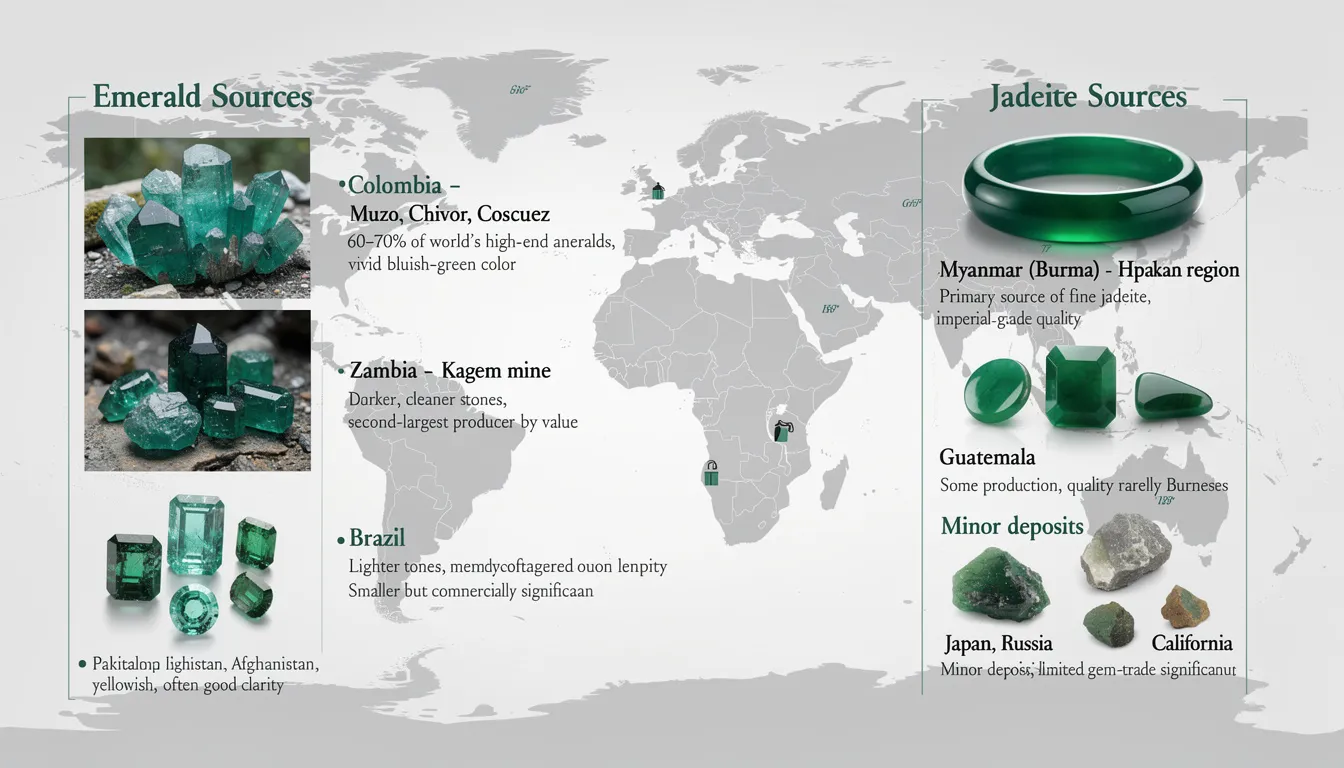
Origin affects everything from color nuance to market value for these two gemstones. Specific geographic names carry prestige and influence what buyers will pay.
Major emerald sources: Sterling Silver Ring with Emerald Gemstone | Handmade 18 Karat Gold-Plated Ring Adorned with Handcrafted Stones
-
Colombia (Muzo, Chivor, Coscuez): Supplies 60–70% of the world’s high-end emeralds; known for vivid, slightly bluish-green color with characteristic inclusions
-
Zambia (Kagem mine): Produces darker, often cleaner stones with bluish modifiers; second-largest producer by value
-
Brazil: Yields lighter stones, sometimes with yellowish tones, often with good clarity
-
Other deposits: Pakistan, Afghanistan, Madagascar, Ethiopia—smaller but commercially significant.
Emeralds from these sources are frequently used in fine jewellery, often paired with different types of gold plating to enhance their appearance and durability.
Major jadeite sources:
-
Myanmar (Burma): Historically and currently the primary source of fine jadeite; the Hpakan region supplies virtually all imperial-grade material
-
Guatemala: Some jadeite production, but quality rarely rivals Burmese material in international markets
-
Japan, Russia, California: Minor deposits exist but are not significant in the gem trade
For context—nephrite sources (often confused with jadeite):
-
China (Xinjiang’s Hetian region), New Zealand, British Columbia, Russia
-
Nephrite is usually softer in appearance and significantly less valuable than jadeite
Origin names carry weight in the market. “Colombian emerald” and “Burmese jadeite” function as quality indicators, even though excellent and poor material exists from every source.
Notable auction references:
-
The 18.04-carat Rockefeller Emerald (Colombian) sold in 2017 for approximately $5.5 million
-
The Hutton-Mdivani jadeite bead necklace (27 beads of Burmese imperial jade) sold in 2014 for $27.4 million—making it the most expensive jade piece ever auctioned
Cultural & Historical Significance
Emerald and jadeite occupy different cultural territories, each with thousands of years of human history and symbolic weight behind them.
Emerald’s cultural heritage:
The Western world has revered emerald since ancient times. Cleopatra’s passion for the stone in Ptolemaic Egypt is legendary—she claimed the Egyptian emerald mines as her personal property. The Romans associated emerald with Venus, goddess of love and beauty. In ancient Egypt, green symbolized fertility, rebirth, and eternal life. Emerald is historically linked to royalty, wealth, and rebirth, particularly in ancient Egypt and European monarchies. Emeralds have been treasured since ancient Egyptian times and were associated with royalty and luxury.
Through medieval Europe and into the modern era, emeralds adorned crowns, religious objects, and aristocratic jewelry:
-
Mughal emperors carved Colombian emeralds with Qur’anic inscriptions, and emeralds were believed to confer wisdom and foresight in Mughal Empire traditions
-
The British Crown Jewels include significant emerald pieces
-
Today, emerald remains the May birthstone and traditional stone for 20th and 55th wedding anniversaries in Western custom
Jadeite’s cultural heritage:
Jade stone holds perhaps no greater significance anywhere than in Chinese culture, where “yu” (jade) has symbolized virtue, nobility, and moral purity for over 7,000 years. Confucius himself praised jade as embodying benevolence, wisdom, and righteousness. Jade is revered as the 'imperial gem' in Chinese dynasties and has been used to create ritual objects and decorative items of great importance. Ritual objects crafted from jade played a central role in ceremonies and symbolized power and spiritual connection.
Important distinctions:
-
Before the 18th century, Chinese jade was primarily nephrite from local sources
-
Burmese jadeite arrived in China via Yunnan during the Qing dynasty and quickly became the imperial gem of choice
-
Imperial jade cabochons and bangles symbolized status, power, and virtue at the Qing court
Māori treasure green nephrite jade as it holds spiritual significance and is carved into heirloom pendants passed down through generations.
Jadeite is valued in Mesoamerican cultures, where it was used in burial rituals to ensure safe passage to the afterlife. Jadeite is primarily associated with spiritual virtues and protection in East Asian and Mesoamerican cultures.
Mesoamerican civilizations including the Maya and Olmec also treasured jade (mostly nephrite and related materials) millennia before Europeans valued emerald—demonstrating jade’s rich history across multiple continents.
Modern symbolism:
-
Emerald: Associated with love, wisdom, and emotional balance; popular for engagement rings; connected to the heart chakra in crystal lore
-
Jadeite: Symbolizes luck, longevity, and prosperity in Asian countries; given at weddings and Lunar New Year; believed to bring harmony and protect the wearer from misfortune
Metaphysical & Astrological Beliefs
Many buyers consider metaphysical and astrological beliefs when selecting gemstones, even if these properties aren’t scientifically verified. Both emerald and jadeite carry rich traditions in this space.
Emerald’s metaphysical associations:
-
Vedic astrology: Linked to the planet Mercury (Budh); believed to enhance intellect, communication, business acumen, and mental clarity
-
Heart chakra: Modern crystal practitioners associate emerald with emotional well being, compassion, and unconditional love
-
Zodiac connections: Often recommended for Gemini and Virgo signs
-
Healing properties: Traditionally thought to support eyesight, memory, and truth-telling
Jadeite’s metaphysical associations:
-
Chinese geomancy (feng shui): Connected to prosperity, protection, and harmonious energy; placed in homes and businesses to attract good fortune
-
Protective qualities: A traditional belief holds that a jade bangle can absorb misfortune on behalf of the wearer—explaining stories of bangles cracking during accidents while the owner remains unharmed
-
Heart chakra: Green jadeite is also linked to the heart chakra, attributed with calming and stabilizing energy
-
Birthstone variations: Some traditions list jade as a mystical birthstone for March
Astrological benefits compared:
|
Belief System |
Emerald |
|
|---|---|---|
|
Vedic (Jyotish) |
Mercury stone; intellect and communication |
Not traditionally used |
|
Western Zodiac |
Gemini, Virgo, Taurus |
Not standardized |
|
Birthstone |
May (official) |
March (mystical/alternative) |
|
Chakra |
Heart |
Heart |
If you’re choosing a stone primarily for spiritual or astrological reasons, consult a qualified astrologer or practitioner familiar with your tradition. Personal resonance matters more than general guidelines.
Price, Value & Record-Breaking Sales
Both jadeite and emerald can be surprisingly affordable at commercial grades—and shockingly expensive at the top. Understanding what drives value helps you shop smarter.
Emerald pricing:
-
Commercial quality: $50–$500 per carat for included, lighter, or heavily treated stones
-
Fine quality: $3,000–$15,000 per carat for well-colored stones with moderate inclusions
-
Exceptional quality: $25,000–$100,000+ per carat for top Colombian emeralds with minimal treatment
Record sale: The Rockefeller Emerald, an 18.04-carat Colombian stone set in a ring by Raymond Yard, sold in 2017 for approximately $5.5 million—roughly $305,000 per carat.
Jadeite pricing:
-
Commercial/treated (Type B/C): $10–$500 per piece for dyed or polymer-impregnated material
-
Fine Type A jadeite: $1,000–$50,000 per piece for untreated cabochons and small carvings
-
Imperial jade: $100,000–$3,000,000+ for exceptional bangles, necklaces, and important carvings
Record sale: The Hutton-Mdivani jadeite bead necklace sold at Sotheby’s Hong Kong in 2014 for approximately $27.4 million, setting the record for any jade piece at auction.
Value drivers compared:
|
Factor |
Emerald |
Jadeite |
|---|---|---|
|
Color |
Vivid, saturated green |
Even, intense green (Imperial) |
|
Clarity/Texture |
Fewer visible inclusions |
Fine grain, no visible spots |
|
Transparency |
Higher = better |
Higher translucency = better |
|
Origin |
Colombian premium |
Burmese premium |
|
Size |
Larger = exponentially rarer |
Thicker bangles, larger cabs = rarer |
|
Treatment |
Minimal oil/no treatment |
Type A (untreated) = premium |
High quality emeralds have a more liquid global market—they sell well at auctions in Geneva, New York, and London. Jade prices spike highest in Greater China markets, where cultural demand drives values that Western buyers may not immediately understand.
Green Gemstone Certification and Authentication
When investing in iconic green gemstones like emerald gemstones or jade stone, certification and authentication are essential steps to ensure you’re getting genuine quality and value. With the market for precious gemstone jewelry—especially engagement rings and high-value collectibles—growing rapidly, buyers are increasingly seeking assurance that their emeralds and jade are authentic, untreated, and sourced responsibly.
Emerald Certification:For emeralds, especially high quality emeralds from renowned sources like Colombian emeralds, certification from respected gemological laboratories is a must. Organizations such as the Gemological Institute of America (GIA) and the International Gemological Institute (IGI) provide detailed reports that verify a gemstone’s origin, color saturation, clarity, cut, carat weight, and any treatments it may have undergone. These certificates are particularly important for distinguishing between natural mined emeralds and lab grown emeralds, which are chemically and optically identical but differ in origin. Certification not only confirms the vivid green color and physical properties of your emerald but also protects your investment by providing documentation that supports its value in the global market.
Jade Certification:Jade, and especially jadeite jade, requires equally rigorous authentication. Since both nephrite jade and jadeite jade are sold under the name “jade,” certification is crucial to confirm you’re purchasing the rarer, more valuable jadeite. Reputable laboratories use advanced testing—such as density measurements, refractive index, and infrared spectroscopy—to determine the type of jade and assess its quality. For collectors and those seeking imperial jade, certification verifies the gemstone’s intense, translucent green hue and fine grain, distinguishing it from lower-value or treated stones. This is especially important as jade prices can vary dramatically based on type, color, and authenticity.
Authentication Process:The authentication process for both emeralds and jade involves a thorough examination of their physical properties and visual characteristics. For emeralds, experts look for natural inclusions (the famous “jardin”), assess color saturation, and check for any enhancements. For jade, the focus is on the evenness of the green color, translucency, and the absence of artificial treatments. Certified imperial jade, with its prized translucent green, commands the highest value and cultural significance, especially in Asian markets.
Market Impact and Buyer Confidence:Certified gemstones consistently command higher prices and greater buyer confidence. For emeralds, especially those from Colombia or Zambia, certification can significantly increase value, as collectors seek assurance of origin and quality. Similarly, certified jadeite jade—particularly imperial jade—fetches premium jade prices, as buyers know they are acquiring a genuine, high quality gemstone with documented provenance.
Practical Advice for Buyers:Whether you’re choosing a vivid green emerald for an engagement ring or a piece of jade jewelry for its cultural significance, always insist on certification from a reputable laboratory. This not only guarantees the authenticity and quality of your gemstone but also ensures its long-term value and desirability. Certified gemstones are easier to insure, resell, and pass down as heirlooms, making them a wise investment for collectors and jewelry lovers alike.
In summary, understanding and prioritizing certification and authentication is key to appreciating the true beauty and worth of emeralds and jade. By selecting certified stones, you can enjoy the rich history, cultural significance, and stunning green hues of these precious and semi-precious gemstones with complete confidence in their authenticity and value.
Choosing Between Jadeite and Emerald
There’s no universal “better” choice between these two gemstones. The right decision depends on your priorities, style, and how you plan to use the piece.
Choose emerald if you:
-
Want a brilliant, sparkling focal stone for a ring or pendant
-
Prefer Western fine jewelry aesthetics with faceted gems
-
Value strong brand recognition and global resale markets
-
Are buying for May birthstone significance or anniversary traditions
-
Plan to wear the piece occasionally with careful handling
Choose jadeite if you:
Interested in learning about other gemstones? Discover the February Birthstone: Amethyst Gemstone and its timeless elegance.
-
Want a bangle, pendant, or carved piece for daily wear
-
Value cultural significance, especially within Chinese or East Asian traditions
-
Appreciate the subtle, glowing quality over flashy brilliance
-
Need durability for an active lifestyle
-
Are building a collection with potential appreciation in Asian markets
Practical considerations:
For a deeper look at the lasting elegance, vibrant colours, and craftsmanship, see 7 Reasons to Love Handmade Gold Plated Mohave Gemstone Jewellery.
-
Lifestyle: If your hands see hard work, jadeite’s toughness is your friend
-
Local market: Resale value depends heavily on where you live—jadeite commands premiums in Hong Kong but may be harder to sell in rural America
-
Cultural meaning: Does the symbolism of one stone resonate more with your heritage or values?
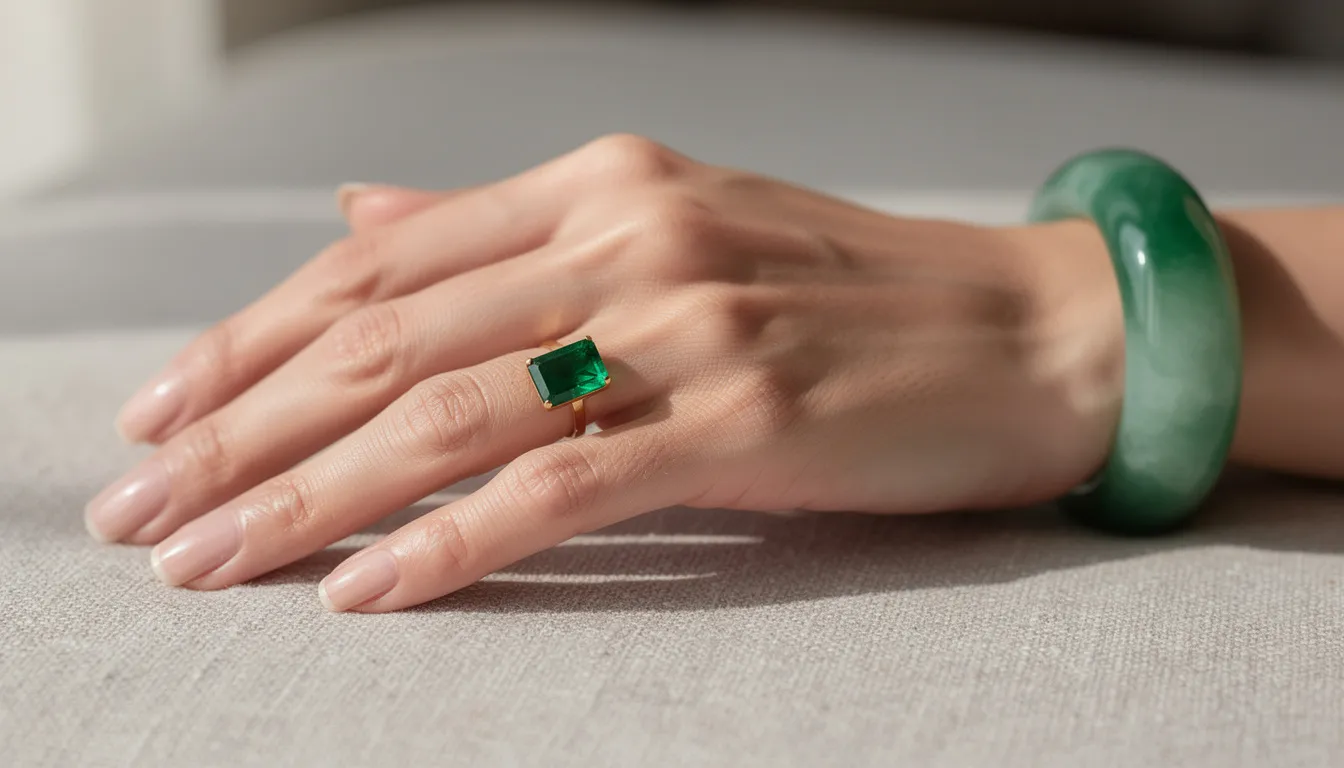
Here’s the good news: you don’t have to choose only one. Many collectors appreciate both—an emerald engagement ring for its crystalline fire and a jade bangle for its protective symbolism and everyday wearability. These two gemstones complement rather than compete with each other in a well-rounded collection.
Care, Cleaning & Treatment Awareness
Both emerald and jadeite require informed care to maintain their beauty and value. Treatments are common for both, and understanding what you’re buying helps you care for it properly.
Emerald treatment and care:
Most emeralds on the market are treated:
-
Oiling/resin filling: Colorless oils (traditionally cedarwood) or synthetic resins fill surface-reaching fractures to improve appearance
-
Degree matters: Minor, moderate, or significant treatment affects both appearance and value
-
Disclosure required: Reputable sellers should disclose treatment level; lab reports specify this for amethyst jewelry pieces as well
Care guidelines for emerald:
-
Clean with lukewarm water, mild soap, and a soft brush only
-
Avoid harsh chemicals, ultrasonic cleaners, and steam cleaners
-
Keep away from sudden temperature changes
-
Remove rings during physical activities
-
Have stones re-oiled periodically if they appear to dry out
Jadeite treatment and care:
The jade trade uses a classification system:
-
Type A: Natural, untreated (may be waxed for polish)—highest value
-
Type B: Chemically bleached and polymer impregnated—significantly lower value
-
Type C: Dyed to enhance color—lowest value
-
Type B+C: Both treatments applied
Care guidelines for jadeite:
-
Clean with mild soap and lukewarm water
-
Avoid harsh chemicals and prolonged exposure to high heat
-
Store separately from harder gems like diamond or sapphire to prevent scratching
-
Be especially gentle with treated (Type B/C) jadeite, as treatments may degrade over time
For significant purchases: Always request independent laboratory certification from recognized labs such as GIA, Gübelin, SSEF (for emerald) or NGTC, Hong Kong Jade and Stone Laboratory (for jadeite). Documentation protects your investment and confirms exactly what you’re buying.
Frequently Asked Questions About Jadeite vs Emerald
How can I tell jadeite from emerald at home?
The easiest distinctions are transparency and luster. Emerald is typically transparent and glassy with visible facets that sparkle. Jadeite is translucent to opaque with a waxy or oily surface sheen and is usually cut as a cabochon or carved. Jadeite also feels heavier for its size due to higher density. For valuable pieces, always get professional gemological testing.
Is jadeite or emerald more expensive on average? For those interested in the significance of these gemstones and more, explore the powerful properties of birthstones.
It depends on quality. Commercial-grade emerald is generally more expensive per carat than commercial jadeite. However, at the top end, imperial jade can exceed emerald prices significantly—the most expensive jadeite necklace sold for $27.4 million compared to top emeralds in the $5–10 million range.
Can jadeite and emerald be worn together?
Absolutely. These stones complement each other beautifully. An emerald ring paired with a jade bangle combines Western brilliance with Eastern cultural significance. Just be mindful that emerald’s lower toughness means it needs more protection than jadeite.
Is jade a good substitute for emerald in engagement rings?
They serve different purposes. Emerald offers the transparent sparkle expected in Western engagement rings, while jadeite provides a softer glow and greater durability. If you want a green gem for heavy daily wear, jadeite may actually be more practical—but it won’t have the same crystalline look that many engagement ring buyers expect.
What’s the difference between jadeite and nephrite?
Both jadeite and nephrite are sold as “jade,” but they’re different minerals. Jadeite is a pyroxene (sodium aluminum silicate) that can achieve vivid imperial green colors and commands premium prices. Nephrite is an amphibole (calcium magnesium silicate) that’s usually softer in color (creamy white, spinach green) and significantly less valuable. Fine jadeite is what’s compared to emerald in the luxury market.
Are emerald and jadeite good investments? If you are interested in unique gemstone jewelry, you might also like this Amazonite raw gemstone necklace.
Both can appreciate, but markets differ. Emerald has consistent global demand from Western collectors and major auction houses worldwide. Jadeite values are heavily influenced by Greater China markets—when Chinese wealth rises, imperial jade prices soar. For either stone, investment-grade pieces need exceptional quality, documentation, and ideally minimal treatment.
How do I avoid fakes or heavily treated stones?
For emerald, request lab reports that specify treatment level (none, minor, moderate, significant). For jadeite, ask for Type A certification from a reputable laboratory. Be skeptical of “too good to be true” prices on vivid green stones—cheap imperial jade or clean Colombian emeralds likely indicate heavy treatment or outright fraud. Buy from established dealers and always get documentation for significant purchases.
Key Takeaways
Understanding jadeite vs emerald comes down to knowing that despite their shared green beauty, these are fundamentally different gems:
-
Emerald is transparent beryl, faceted for brilliance, prized in Western culture, and ideal for protected jewelry settings
-
Jadeite is tough pyroxene aggregate, carved or cut cabochon, revered in East Asian culture, and built for daily wear
-
Both can reach extraordinary prices at top quality, but their value drivers and markets differ significantly
-
Treatment is common for both—always ask for disclosure and lab certification on valuable purchases
Whether you’re drawn to emerald’s electric sparkle or jadeite’s serene glow, understanding these differences ensures you’ll make an informed choice that matches your style, values, and lifestyle.
Start by considering how you’ll actually wear the piece. If it’s a special-occasion ring you’ll treat carefully, emerald’s brilliance makes a statement. If it’s a bangle or pendant for everyday life, jadeite’s legendary toughness will serve you well for years to come.
Leave a comment