

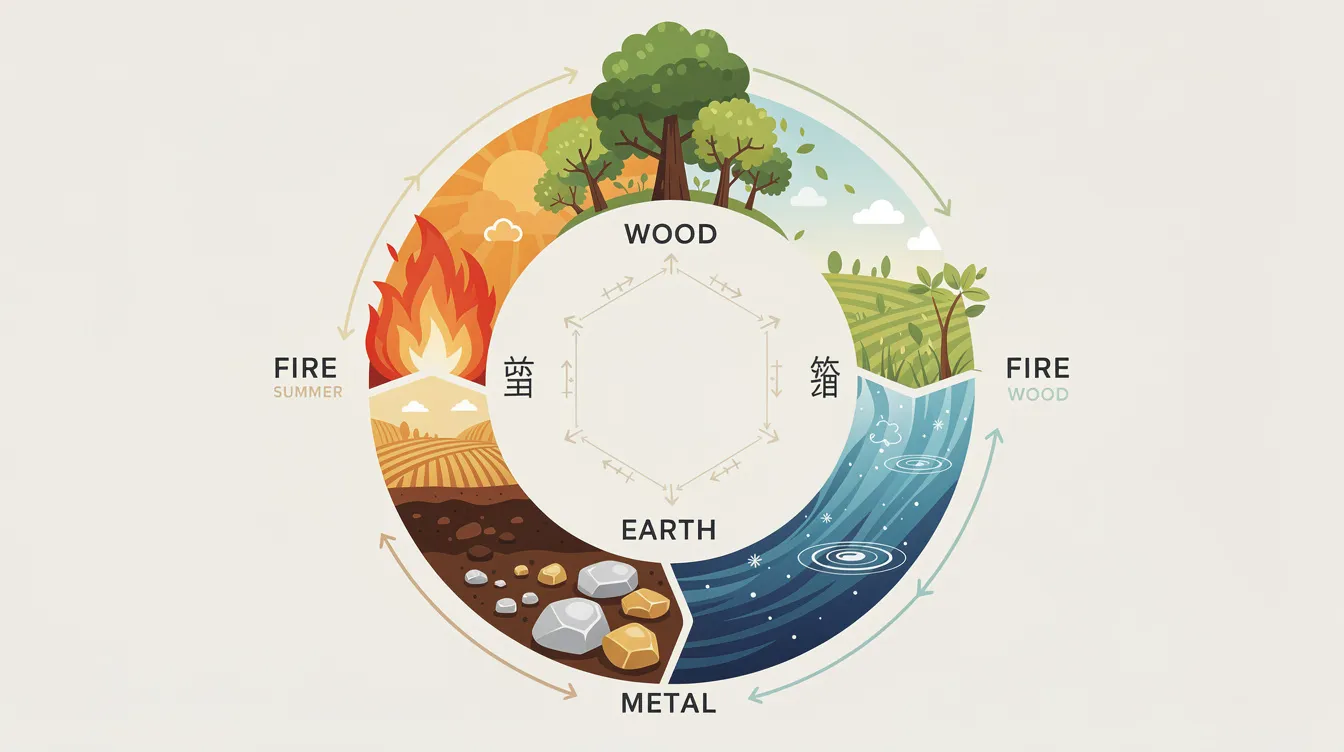
The Five Elements Theory, known as Wuxing in Chinese philosophy, forms one of the most enduring frameworks for understanding how the world changes and how balance is maintained. These five fundamental elements—Wood, Fire, Earth, Metal, and Water—are not static substances but dynamic phases that describe movement, transformation, and interconnection across nature, the human body, and the cosmos.
Wuxing literally translates to “five phases” or “five movements,” emphasizing that these elements represent ongoing processes rather than fixed materials. Five Elements Theory first appeared during the Spring and Autumn Period (770–476 BC) and is widely used in Chinese medicine, philosophy, feng shui, fortune-telling, and martial arts. In 2026, this ancient system continues to guide TCM practitioners in clinics from Shanghai to San Francisco, feng shui consultants in Hong Kong high-rises, and Chinese astrology apps calculating your birth year element.
Each element carries specific characteristics: Wood embodies growth and flexibility, Fire represents warmth and transformation, Earth signifies nourishment and stability, Metal conveys structure and clarity, and Water symbolizes fluidity and wisdom. Together, these five phases explain everything from why one dynasty replaced another to which foods support your person’s constitution.
History and Origins of the Five Elements Theory
The elements theory emerged as early Chinese thinkers sought patterns connecting natural cycles, political shifts, and bodily functions. Rather than accepting chaos, scholars observed that nature moved through predictable phases—seasons turning, rivers rising, empires falling—and sought a unified explanation.
The earliest clear references appear in texts from the late Western Zhou and early Spring and Autumn Period, around the 9th to 8th centuries BC. The Zuozhuan and Guoyu contain discussions linking the five phases to governance and natural phenomena. During the Warring States Period (475–221 BC), the scholar Zou Yan of the Yin-Yang School systematized Wuxing and connected the cycles to dynastic successions, arguing that each ruling house governed under a specific elemental virtue.
By the Han dynasty (206 BC–220 AD), the five elements theory had become central to state ideology. Texts like the Huainanzi and Lüshi Chunqiu integrated Wuxing into medicine, astrology, and court ritual. Early Greeks believed that the elements Fire, Air, Water, Earth, and Aether comprised the physical and celestial worlds, while medieval alchemists used the classical elements as symbols for both chemical processes and spiritual refinement—but the Chinese system uniquely emphasized cyclical transformation rather than fixed substances.
Today, Wuxing remains taught in traditional Chinese medicine universities across mainland China and Taiwan, practiced in feng shui schools, and preserved in martial arts lineages worldwide.
Core Associations of the Five Elements
Each of the five elements in the Five Elements Theory is associated with specific characteristics and aspects of nature, including direction, season, color, and shape. These correspondences form a systematic map used in TCM diagnosis, feng shui consultation, and astrological interpretation.
Wood
Wood is associated with spring, the east, and green or blue-green colors. It governs growth, vitality, and flexibility. In the body, wood element relates to the liver and gallbladder, with anger as its emotional expression when out of balance. Trees bending in wind exemplify Wood’s resilient nature.
Fire
Fire is linked to summer, the south, and red. It represents warmth, enthusiasm, and upward energy. The fire element governs the heart and small intestine, with joy or agitation as its emotional markers. Think of flames rising and transforming everything they touch.
Earth
Earth is tied to late summer and seasonal transitions, the center direction, and yellow. It signifies nourishment, stability, and common sense. Earth governs the spleen and stomach, with pensiveness and worry emerging when imbalanced. The element embodies nurturance, like soil supporting crops.
Metal
Metal is connected to autumn, the west, and white. It conveys structure, discipline, and clarity. The metal element rules the lungs and large intestine, with grief and letting go as emotional themes. Metal represents refinement and precision.
Water
Water is related to winter, the north, and black or deep blue. It symbolizes fluidity, wisdom, and storage. Water governs the kidneys and bladder, with fear and willpower as its emotional expressions. The element embodies adaptability, flowing around obstacles.
In Ayurveda, the elements are used to assess dietary needs based on individual constitution. Yoga connects the elements to the sensory organs, with Space linked to hearing and the ears. Ayurveda groups five elements—Earth, Water, Fire, Air, and Space/Ether—into three doshas (Vata, Pitta, and Kapha) to determine a person’s constitution, while modern spiritual practices may use tools like chakra bracelets for balance and well-being or other energy bracelets made with healing gemstones to work with subtle energy centers. While these Eastern systems share elemental thinking, the Chinese framework uniquely emphasizes cyclical interactions.
Interaction Cycles: Generating and Overcoming
The five elements do not exist in isolation. They interact through two primary cycles that describe how change and balance occur throughout nature and the human body.
The Five Elements Theory asserts that the world changes according to the generating or overcoming relationships between the five elements, which are complementary processes of yin yang. The elements follow “Generating” and “Overcoming” cycles to explain natural changes in Traditional Chinese Medicine.
The Generating (Sheng) Cycle describes how elements support and nurture each other. Wood feeds Fire, as fuel enables flames. Fire creates Earth, leaving ash behind. Earth bears Metal, as minerals form within rock. Metal enriches or carries Water, through condensation or as conduits. Water nourishes Wood, enabling growth. The five generating interactions of the five elements include fueling, forming, containing, carrying, and feeding, which are likened to nurturing relationships. Generating interactions among the five elements promote development.
The Overcoming (Ke) Cycle describes how elements control and restrain each other. Metal chops Wood. Wood roots break Earth. Earth dams and contains Water. Water quenches Fire. Fire melts Metal. The five overcoming interactions of the five elements are melting, penetrating, separating, absorbing, and quenching, which represent hostile acts between opposing forces. Overcoming interactions control development, thus harmonizing and maintaining balance in systems.
In practice, these cycles work positively to strengthen weak phases or negatively when one element exhausts or attacks another. A skilled TCM practitioner or feng shui consultant applies these dynamics to restore balance rather than create conflict.
Five Elements in Cosmology and Feng Shui
Ancient Chinese cosmology used the Five Elements to describe the structure of the universe, compass directions, and the flow of qi—the vital life energy animating all things. This cosmological framework became the foundation for feng shui practice.
A key principle of Feng Shui is balancing the elements to harmonize the energy of a living space. In 2026, feng shui practitioners in Hong Kong, Taipei, Singapore, and Chinatowns worldwide continue applying Wuxing principles to urban apartments and commercial spaces. Apps with millions of downloads now combine traditional compass readings with AI-generated recommendations.
Each element corresponds to specific compass directions:
-
Wood governs the east and southeast
-
Fire rules the south
-
Earth centers and extends to northeast and southwest
-
Metal controls the west and northwest
-
Water dominates the north
Qi flows through buildings and landscapes according to these elemental zones. The generating cycle creates supportive energy—placing a water fountain in the north energizes the Water sector, which then nourishes Wood in the east. The overcoming cycle explains conflicts—too much Fire (bright red décor) in a Water person’s northern bedroom creates stagnation.

Concrete feng shui remedies for a modern apartment might include:
-
Placing wooden furniture or leafy greens in eastern study areas to boost creativity
-
Adding metallic desk organizers in western work zones for clarity
-
Using yellow ceramics in center dining areas to support digestive health
-
Installing small water features in northern sectors to enhance career energy
Practitioners caution against excess—balance remains the goal, not overwhelming any single element.
Dynastic Cycles and Political Legitimacy
In classical Chinese political thought, the Five Elements explained why one dynasty replaced another under the Mandate of Heaven. Each ruling house claimed an elemental “virtue” that legitimized its reign and predicted its eventual replacement.
The elements carried political colors and cosmic significance:
-
Wood virtue corresponded with green
-
Fire virtue with red
-
Earth virtue with yellow
-
Metal virtue with white
-
Water virtue with black
The Qin dynasty (221–206 BC) claimed Water virtue and adopted black as its imperial color after conquering the Fire-associated Zhou. The Western Han dynasty (206 BC–220 AD) shifted to Earth virtue, making yellow the dominant imperial color seen in robes and palace design. Later dynasties continued this pattern—the Tang invoked Fire, the Song claimed Metal, the Yuan adopted Water, the Ming emphasized Wood, and the Qing returned to Water.
Scholars interpreted natural disasters through this lens. Floods suggested Water overwhelming Fire rulers. Droughts indicated Earth weakness. Eclipses and earthquakes became cosmic signals that the current dynasty’s element was being overcome, justifying rebellion. This framework influenced court rituals, sacrificial ceremonies, and capital city orientations through the Qing dynasty’s fall in 1912.
Five Elements in Traditional Chinese Medicine (TCM)
In Traditional Chinese Medicine, the Five Elements Theory is used to classify the human body’s influences on organs, physiological activities, and pathological reactions, aiding in diagnosis and treatment. Modern TCM, practiced in over 3,000 hospitals across mainland China and clinics worldwide, continues using Wuxing as a diagnostic framework.
Organ Correspondences
The core organ correspondences are:
-
Wood: Liver and Gallbladder
-
Fire: Heart, Small Intestine, Pericardium, and Triple Burner
-
Earth: Spleen and Stomach
-
Metal: Lungs and Large Intestine
-
Water: Kidneys and Bladder
Emotional Associations
Chinese medicine practitioners interpret symptoms through element relationships:
-
Wood (Anger): Excessive anger disrupts liver qi and may over-control Earth, creating stomach issues.
-
Fire (Joy/Agitation): Fire agitation can cause insomnia and restlessness.
-
Earth (Pensiveness/Worry): Chronic worry weakens digestion, causing digestive problems.
-
Metal (Grief): Unresolved grief manifests as sore throats, coughs, or skin problems.
-
Water (Fear): Fear depleting Water can cause health problems like chronic fatigue or weakened willpower.
Treatment Approaches
Treatments leverage the generating and overcoming cycles:
-
For Fire agitation causing insomnia, a practitioner might nourish the preceding Water element with kidney tonics like black sesame, adjust bedtime routines, and recommend cooling foods.
-
For Wood overacting on Earth—liver qi stagnation impairing spleen digestion—Metal herbs might restrain excess Wood.
-
Acupuncture point selection follows similar logic. Needling Liver 3 drains Wood excess while Kidney 3 tonifies Water.
-
Seasonal dietary advice encourages:
-
Sour foods in spring for liver support
-
Bitter foods in summer for heart health
-
Sweet foods in late summer for spleen nourishment
-
Pungent foods in autumn for lung function
-
Salty broths in winter for kidney strength
-
Five Elements in Chinese Martial Arts
Several internal martial arts organize techniques explicitly around the Five Elements, training body mechanics, breath control, and combat intent through elemental principles.
Xingyiquan (Shape-Mind Fist) provides the clearest example. Tracing to 17th-century Shanxi lineages and masters like Ji Jike, this art structures core training around five basic fists:
-
Pi Quan (splitting): expresses Metal—chopping downward with precision
-
Zuan Quan (drilling): embodies Water—spiraling penetration through defenses
-
Beng Quan (crushing): represents Wood—explosive forward thrusting
-
Pao Quan (pounding): channels Fire—cannon-like bursting power
-
Heng Quan (crossing): demonstrates Earth—horizontal stability and rooting
Students drill these fists in generating sequences—Wood to Fire to Earth to Metal to Water—to build rhythmic power transitions. Overcoming sequences train counters: if an opponent attacks with Fire energy, respond with Water’s fluid deflection.
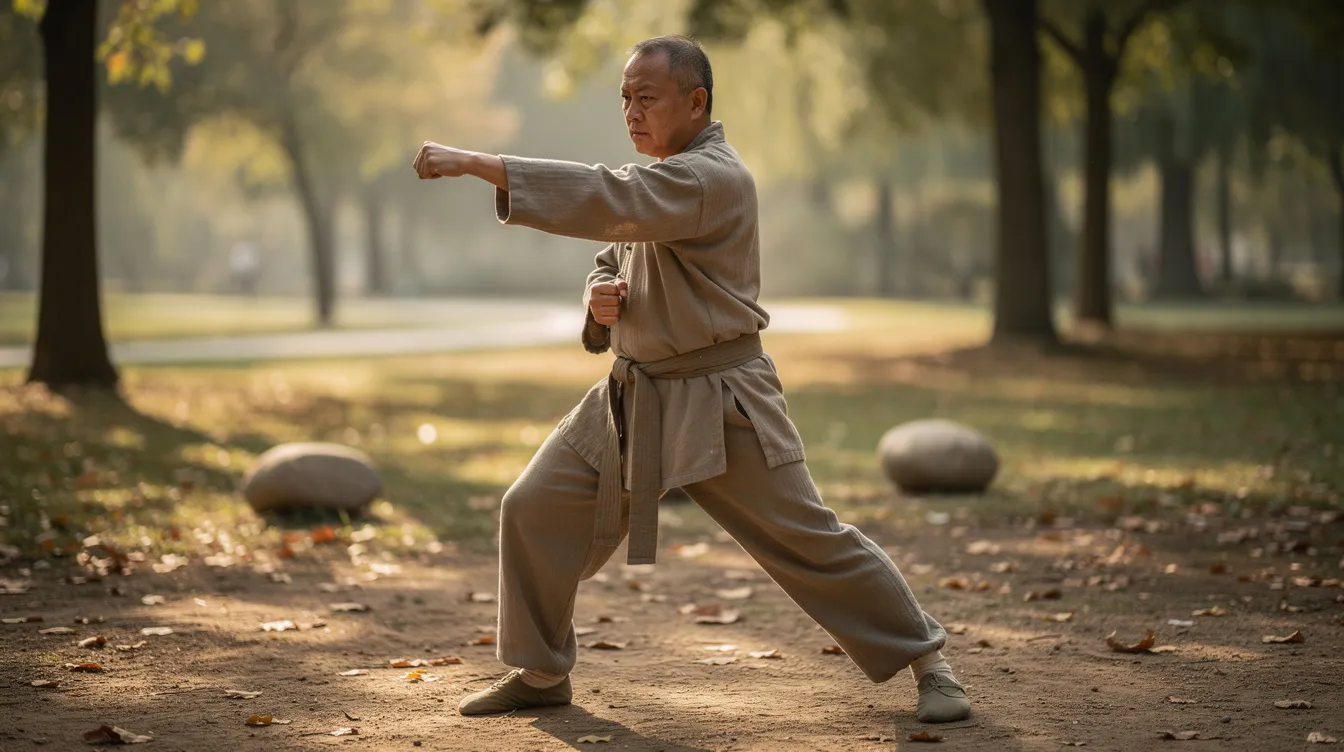
Taijiquan (tai chi) and Baguazhang lineages also reference Wuxing. Water fluidity appears in silk-reeling exercises. Seasonal forms emphasize Earth centering in late summer. Practitioners use elemental awareness for emotional well being during training—channeling anger into Wood’s explosive forward energy while cultivating Metal’s refined defensive poise.
In 2026 classes from Beijing parks to New York dojos, students continue learning these ancient patterns, connecting breath, intent, and movement through five elemental expressions.
Five Elements and the Chinese Zodiac
In Chinese astrology, the 12 zodiac animals combine with the Five Elements to create a 60-year cycle describing personality traits, fate, and timing. Understanding your chinese zodiac sign requires knowing both your animal and your element.
Each chinese zodiac year carries both an animal sign and a “heavenly stem” element. Someone born in the year of the monkey in 2016 is a Fire Monkey, while 2024 is a Wood Dragon year. The next monkey year arrives in 2028 as an earth monkey year.
In Chinese astrology, each of the 12 zodiac signs is associated with one of the five elements, which influences personality traits and fortune. The fixed element of a zodiac sign is determined by the month of the traditional Chinese solar calendar, while the element of the 12-year cycle is based on the year of birth.
Zodiac Animal-Element Associations
|
Zodiac Animal |
Fixed Element |
|---|---|
|
Tiger |
Wood |
|
Rabbit |
Wood |
|
Monkey |
Metal |
|
Rooster |
Metal |
|
Pig |
Water |
|
Rat |
Water |
|
Snake |
Fire |
|
Horse |
Fire |
|
Ox |
Earth |
|
Dragon |
Earth |
|
Goat |
Earth |
|
Dog |
Earth |
|
Monkeys born in different years will have different personalities due to the association of their zodiac sign with one of the five elements: Metal, Water, Wood, Fire, or Earth. A wood monkey tends toward creativity and flexibility. A water monkey shows emotional intelligence and adaptability. People born as Metal Monkeys display strong self esteem and determination. An earth monkey demonstrates stability and practical wisdom. |
|
Important date considerations: the chinese lunar calendar year begins on Lunar New Year, typically falling in late january through mid-February. The 2028 Year of the Earth Monkey starts January 26, 2028, and ends February 12, 2029. Anyone born before that date in 2028 belongs to the previous sign and element. People born under monkey year signs tend to be quick witted and fast learners with many interests, sometimes becoming crafty opportunists who prefer urban life and practical jokes.
Notable people born under monkey signs include Tom Hanks. Lucky numbers and favorable directions vary based on element combinations. For precise results based on your birth date, use online chinese zodiac calculators that factor in month and lunar month positions. Advanced Bazi (four pillars) astrology examines year, month, day, and hour stems for comprehensive element analysis across all five types of elements.
Using Five Elements Theory for Luck and Daily Life
Beyond philosophy, many people in 2026 apply chinese element theory for practical decisions—home décor, color choices, desk placement, and timing key events. The goal is achieving balance and supporting favorable energy flow.
To identify your personal element, start with online Bazi calculators using your birth year and birth date. Once you know your dominant or favorable element, support it using the generating cycle. If your favorable element is Wood, emphasize Water (which feeds Wood) and Wood itself through colors and materials in living spaces, and consider shopping intentionally for crystals aligned with your elements to reinforce those qualities.
Feng Shui Applications
-
Placing green or blue décor and trees or plants in east-facing home offices activates Wood for creativity
-
Adding gold or white metallic accents westward refines Metal clarity for remote work focus
-
Installing small fountains in northern areas strengthens Water for career flow
-
Using yellow earth tones in center dining spaces supports digestive health
-
Avoiding Fire reds in bedrooms if Water dominates your chart prevents energy conflict
Feng shui practitioners align beds toward auspicious directions based on personal element charts. Desks face directions supporting professional goals. Door orientations receive analysis using compasses and the 24 mountains sub-directions system.
Seasonal eating follows elemental patterns. Spring emphasizes sour foods for liver support. Late summer focuses on sweet, nourishing foods. Autumn includes pungent foods for lung health. Winter features salty broths for kidney strength. Alongside food therapy, some people also explore healing crystals and gems for wellness and energy balance and wearing a bracelet crystal daily as complementary tools for emotional regulation and energy support. These dietary choices support emotional well being and seasonal energy transitions.
However, experts caution against rigid adherence. The Five Elements work best as a reflective framework combined with practical considerations—lighting, ergonomics, personal taste, and own interests. Urban life in small apartments requires creative, compact remedies. Bad luck interpretations shouldn’t override common sense.
The Five Elements bridge traditional wisdom and modern living, offering intuitive guidance without demanding dogmatic compliance. Whether arranging a home office, understanding compatibility with a dragon or tiger partner, or choosing colors for a renovation, Wuxing provides a lens for examining balance in the world around you. The nature of these elements isn’t rigid rules but dynamic relationships—wood fire earth metal water, cycling through generation and restraint as opposed forces find harmony.
Start with your birth chart, observe how elemental balance feels in your life, and experiment with small adjustments. The finish line isn’t perfection but awareness of the energy flowing through your spaces and decisions.
Leave a comment